
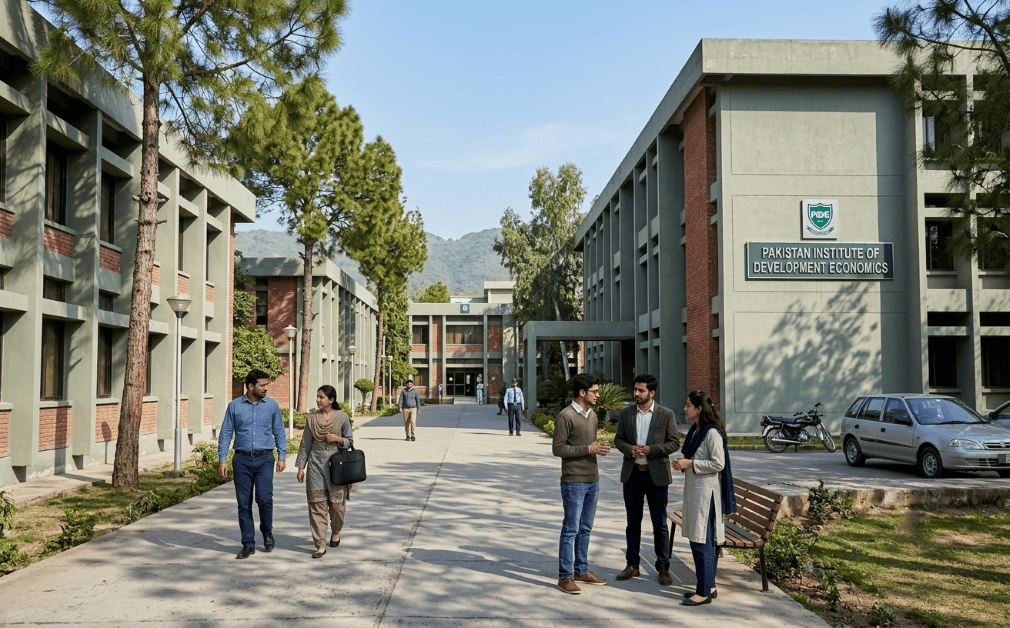
Let us cut through the noise. If you are serious about economics, public policy, or data-driven research in Pakistan, there is one name that keeps coming up: PIDE. The Pakistan Institute of Development Economics sits on the Quaid-i-Azam University campus in Islamabad and has been around since 1957. It is not just a university. It is a think tank, a research powerhouse, and a direct pipeline into Pakistan’s policy-making world.
But here is what students actually want to know. Is it hard to get into? What does it cost? Will you get a job afterward? Can you survive on that campus? And is the “think tank” thing just marketing fluff?
I have pulled together every official detail, fee slip, and admission rule to give you the real picture. No fluff. Just answers.
What Is PIDE, Really?
PIDE was founded in 1957. That makes it one of the oldest economic research institutions in South Asia. It operates under the Ministry of Planning Development & Special Initiatives and functions as an autonomous, degree-awarding university recognized by the Higher Education Commission (HEC) of Pakistan.
But here is what makes it different from your average university. PIDE is a think tank that also teaches. Faculty members are not just professors. They are economists who advise the government, publish policy papers, and show up in Senate committee hearings. As a student, you are not just reading textbooks. You are sitting in seminars where people debate the national budget, trade deficits, and poverty statistics in real time.
Quick Facts:
| Detail | Info |
| Full Name | Pakistan Institute of Development Economics |
| Location | Quaid-i-Azam University Campus, Margalla Road, Islamabad |
| Type | Public-sector, autonomous, postgraduate research university |
| Established | 1957 |
| Student Body | Very small (around 250–500 students total) |
| Phone | 051-9248098 |
| [email protected] / [email protected] | |
| Website | pide.org.pk |
Because it is on the QAU campus, you get access to one of the most beautiful university settings in Pakistan. Margalla Hills in the background. Clean air. A proper library. It does not feel like a cramped city college.
What Can You Study? (All Programs)
PIDE is not a general education university. It does not offer MBBS or engineering. Everything here revolves around economics, policy, data, and governance. Here is the full list:
Undergraduate Programs (BS — 4 Years)
| Program | School |
| BS Economics | School of Economics |
| BS Business Analytics | School of Economics |
| BS Accounting & Finance | School of Economics |
| BS Public Policy | School of Policy, Development & Governance |
Heads up: The BS programs are relatively new. PIDE has historically been a graduate-only institute. So if you are applying for undergrad, you are part of a smaller, newer cohort. That can be good — more attention from faculty — but the graduate programs are where PIDE’s real reputation sits.
Graduate Programs (MPhil / MS — 2 Years)
| Program | Focus Area |
| MPhil Economics | Core economic theory, modeling, policy |
| MPhil Econometrics | Data analysis, statistical modeling, machine learning |
| MPhil Development Studies | Poverty, inequality, institutional economics |
| MPhil Public Policy & Governance | Political economy, public administration |
| MPhil Business Economics | Corporate strategy, market analysis |
| MPhil Economics & Finance | Financial markets, monetary policy |
| MS Project Management | Development project design and evaluation |
The School of Economics faculty specializes in microeconomics, macroeconomics, international trade, monetary and fiscal policy, economic modeling, and even behavioral economics.
The School of Policy, Development and Governance covers political economy, anthropology, institutional economics, labor economics, and critical management studies.
Doctoral Programs (PhD — 3 to 5 Years)
| Program | Research Focus |
| PhD Economics | Advanced economic theory and policy |
| PhD Econometrics | Quantitative methods and data science |
| PhD Development Studies | Sustainable development, social policy |
| PhD Public Policy & Governance | Governance frameworks, policy evaluation |
PhD students must submit a research proposal and defend it in an academic interview. This is not a place where you drift through coursework. You are expected to produce original research from day one.
Fee Structure: The Real Numbers
Here is where PIDE shocks people — in a good way. This is a public-sector institute with heavy government subsidy. The fees are a fraction of what private universities charge for similar programs.
Undergraduate (BS Programs)
| Fee Type | Amount (Approx. Per Semester) |
| Tuition & Associated Fees | PKR 50,000 – 65,000 |
Graduate (MPhil / MS Programs)
| Fee Type | Amount (Approx. Per Semester) |
| Tuition & Associated Fees | PKR 64,000 – 85,000 |
Doctoral (PhD Programs)
| Fee Type | Amount (Approx. Per Semester) |
| Tuition & Associated Fees | PKR 76,000 – 95,000 |
One-Time & Extra Charges
- Admission / registration fee (one-time)
- Library deposit (refundable)
- Thesis evaluation charges (final semester for MPhil/PhD)
Even at the PhD level, you are paying less per semester than many private colleges charge for a single month. Over a full two-year MPhil, you might spend under PKR 1.5 million total including all extras. That is genuinely affordable for a research degree.
Admission Process: Step-by-Step
PIDE has a selective admission policy. The acceptance rate hovers around 50–59%, so it is competitive but not impossible. Here is exactly how to apply without missing anything.
Step 1: Check Your Eligibility
For BS Programs:
- Minimum 50% aggregate marks in Intermediate
- Accepted: FA, FSc (Pre-Engineering or Pre-Medical), ICS, I.Com
- A-Levels accepted with IBCC equivalence certificate
For MPhil / MS Programs:
- 16 years of education in a relevant field (BS Economics, Math, Statistics, or Social Sciences)
- Minimum 2.5/4.0 CGPA or 50% marks under the annual system
- Passing score on the PIDE Departmental Entry Test or NTS GAT-General
For PhD Programs:
- 18 years of relevant education (MPhil/MS with a research thesis)
- Minimum 3.0/4.0 CGPA
- A submitted research proposal
- Passing score on GRE / GAT-Subject
- Academic interview
Step 2: Apply Online
Go to admissions.pide.org.pk and fill out the application. Upload your documents. Pay the application fee.
Step 3: Prepare Your Documents
You will need:
- Attested academic transcripts (Matric through latest degree)
- CNIC or B-Form
- Domicile
- Passport-size photographs
- Personal statement (especially for graduate programs)
- Letters of recommendation (for PhD)
- Research proposal (for PhD)
Step 4: Sit the Entry Test
For MPhil and PhD, the entry test is mandatory. It covers:
- Quantitative ability (math, statistics)
- Economics concepts (for economics programs)
- Analytical reasoning
- English comprehension
Tip: Brush up on basic calculus, probability, and introductory economics. The test is not GRE-level hard, but it assumes you remember your undergrad basics.
Step 5: Interview (MPhil & PhD)
Shortlisted candidates face a faculty panel. They will ask about:
- Your academic background
- Why you chose this field
- Your research interests (for PhD)
- Current economic issues in Pakistan
Do not say: “I want to do MPhil because I could not find a job.”
Do say: “I have been following PIDE’s research on trade policy, and I want to contribute to work on regional trade agreements.”
Step 6: Merit List & Fee Deposit
Merit lists are published online. If you make the cut, deposit your fee by the deadline. Seats are limited. Do not delay.
Scholarships & Financial Support: You Can Actually Afford This
PIDE is already cheap. But if you still need help, there are multiple options.
HEC Need-Based Scholarships
Full tuition coverage plus monthly stipends for students from low-income families. You submit income proof, tax returns, and expenditure details. Check the latest HEC scholarships and grants page for deadlines and eligibility.
PEEF / NEST Scholarships
- Punjab Educational Endowment Fund (for Punjab domicile holders)
- National Education Endowment Fund (for MPhil/PhD scholars nationwide)
Research Assistantships (RAs)
This is the big one. PIDE regularly hires its own MPhil and PhD students as Research Assistants on government policy projects, UNICEF programs, GIZ-funded studies, and internal research publications.
You work on real policy papers. You get paid. You build your CV. Some RAs effectively cover their living expenses through this work.
Work-Study Program
PIDE mentions a work-study program paying around PKR 80,000 per month. This is likely for advanced graduate students working closely with faculty on major research projects.
Campus Life: What Is It Actually Like?
PIDE is small. Around 250 to 499 students total. That means you are not a face in a crowd. Faculty know your name. You get invited to seminars. It feels more like a research community than a typical university.
Facilities
- Library: Yes, with access to economic databases and journals
- Housing: Hostel accommodation is available
- Sports: Basic sports facilities exist, though this is not a sports campus
- Computer labs: For data analysis and econometric work
- Seminar halls: Regular policy talks and research presentations
The Vibe
Because you are on the QAU campus, you share space with thousands of other students. There are cafeterias, bookshops, and walking paths under pine trees. The atmosphere is intellectual. People argue about inflation rates over tea. It is quiet compared to Lahore or Karachi campuses. If you want nightlife, Islamabad is not the place anyway. But if you want to focus, it is ideal.
Hostel & Living
Hostel rooms are available, though limited. Many graduate students prefer to rent shared flats in nearby sectors like G-9, G-10, or F-10. A decent single room in these areas costs between PKR 15,000 to 25,000 per month. Food is cheap if you use campus cafeterias or local dhabas.
Jobs After PIDE: Will You Actually Get Hired?
PIDE claims 95% employability within 6 months of graduation. That is a bold claim, but it is not hard to believe when you look at where graduates end up.
Where PIDE Graduates Work
- Government: Ministry of Finance, Planning Commission, State Bank of Pakistan, Bureau of Statistics
- International organizations: World Bank, IMF, UNICEF, UNDP, Asian Development Bank
- Research institutes: PIDE itself, SDPI, PRIME Institute, think tanks
- Banks and corporates: HBL, UBL, Engro, Nestle (in analytics and strategy roles)
- Academia: Lecturers and professors at universities across Pakistan and abroad
Why Employers Like PIDE Graduates
- Strong quantitative training (econometrics, statistics, data modeling)
- Policy writing skills
- Research experience through thesis work and assistantships
- Direct exposure to government projects
Starting salaries vary. A fresh MPhil graduate joining a bank or consultancy might start at PKR 60,000–90,000. PhD graduates and those who land international organization roles can start much higher. Government jobs through CSS or direct recruitment offer stability and long-term growth.
PIDE vs Other Economics Programs: Honest Comparison
| Factor | PIDE | Private Universities (LUMS, IBA, etc.) |
| Fee (MPhil) | ~1.3–1.7 million total | 3–6 million total |
| Degree Recognition | HEC-recognized, government-backed | HEC-recognized |
| Faculty | Policy-active researchers | Often academically strong, less policy-focused |
| Research Exposure | Direct access to government projects | More theoretical, less applied |
| Class Size | Very small, personalized | Larger cohorts |
| Campus Life | Quiet, academic, on QAU campus | More social activities, urban locations |
| Placements | Strong in government, think tanks, IOs | Strong in corporates, banks, multinationals |
My honest opinion? If you want to work in policy, research, or government, PIDE is arguably the best value in Pakistan. If you want a corporate finance career at a multinational, LUMS or IBA might have stronger brand recognition. But for pure economics and public policy training, PIDE punches way above its fee level.
Pros and Cons (No Sugarcoating)
Pros
- Cheapest quality graduate economics education in Pakistan
- Direct link to government policy-making
- Small class sizes with accessible faculty
- Research assistantships that pay
- Beautiful QAU campus location
- Strong alumni network in government and international organizations
- 95% claimed employability within 6 months
Cons
- Very small student body — can feel isolating
- Limited undergraduate social life compared to big universities
- Hostel space is limited
- Not a “brand name” for corporate jobs like LUMS or IBA
- PhD programs are rigorous — not for casual students
- Islamabad living costs are higher than Lahore or Peshawar
Frequently Asked Questions
Yes. It is a public-sector autonomous institute operating under the Ministry of Planning Development & Special Initiatives.
Usually around early August for the Fall intake. Check pide.org.pk for the exact deadline.
Yes. Provisional admission is possible for students awaiting final results.
Not at the intermediate level, but for graduate programs in economics and econometrics, strong math and statistics skills are expected.
Not officially as a dedicated service, but being on the QAU campus, public transport and van services are easily accessible.
Need-based scholarships require documentation and committee approval. Research assistantships usually open after you have enrolled and proven yourself.
PIDE offers paid research work to selected graduate students, reportedly around PKR 80,000 per month. It is competitive and based on merit.
Yes. Graduates work in government ministries, the State Bank, international organizations, banks, and research institutes.
Yes. International students are welcome. Contact the admissions office for equivalence requirements.
No formal age limit is stated, but check the latest admission notice for any updates.
Economics focuses on theory and policy. Econometrics focuses on data modeling, statistical methods, and quantitative analysis. Pick econometrics if you want to work with data.
Final Word: Should You Apply?
Here is the truth. PIDE is not for everyone. If you want a typical university experience with concerts, sports festivals, and a massive social scene, you will find it too quiet. If you want to study business administration or computer science, PIDE does not offer those programs.
But if you care about economics, policy, data, and research — if you want to understand why Pakistan’s economy works the way it does and maybe fix it — PIDE is one of the best places in South Asia to start. The fees are low. The faculty is engaged. The research opportunities are real. And the alumni network opens doors in places where policy actually gets made.
My advice? If you meet the eligibility criteria, apply. Prepare for the entry test. Write a genuine personal statement. And if you get in, treat it like a job. Show up to seminars. Volunteer for research projects. Talk to professors after class.
The return on investment here is hard to beat.
Good luck.