
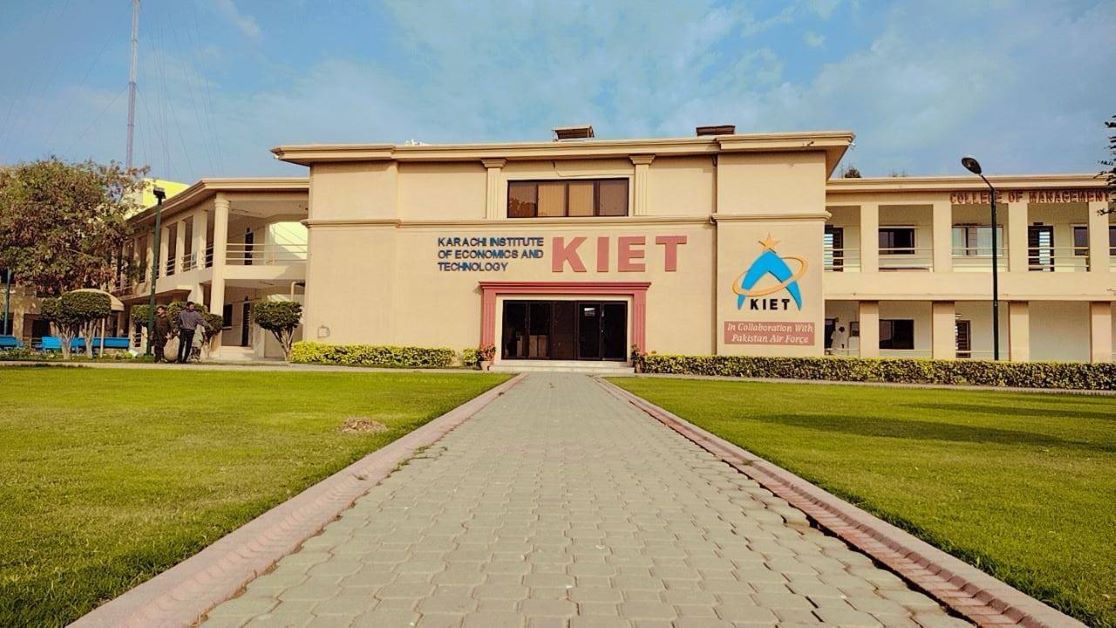
Karachi Institute of Economics & Technology (KIET) is a private higher education institution in Karachi, founded in 1997. It is recognized by the Higher Education Commission (HEC), with relevant programmes having accreditation associated with the National Computing Education Accreditation Council (NCEAC) and Pakistan Engineering Council (PEC).
KIET focuses on business, technology, engineering, innovation and research. Its academic approach aims to give students practical skills that can help them respond to changing industry and workplace demands.
About Karachi Institute of Economics & Technology
KIET was established in 1997 with the goal of providing quality education at an affordable cost. Over time, the institute has expanded its academic offerings while maintaining a focus on technology, entrepreneurship, research and professional development.
The institute aims to combine a supportive academic environment with programmes designed around modern industry requirements. Its stated vision focuses on education, innovation, research and developing future leaders and entrepreneurs.
Institute type: Private
Location: Karachi, Sindh
Established: 1997
HEC status: Recognized by the Higher Education Commission
Accreditation: NCEAC / PEC for relevant programmes
Study levels listed: Diploma, Associate Degree and Bachelor’s
Official website: https://kiet.edu.pk/
Is KIET co-educational?
The supplied information doesn’t specify a separate gender policy. Students should confirm the current admission and campus policy directly with KIET before applying.
Programs and Degrees
KIET offers study options at different levels, including short diplomas, associate degrees and four-year bachelor’s programmes.
Diploma Programmes
Duration: 1 to 4 months
Diploma programmes provide short-term education or skills development. The duration depends on the specific course selected.
Students should check KIET’s current diploma list to see which subjects and professional areas are available.
Associate Degree Programmes
Duration: 2 years
Associate degree programmes provide a two-year higher education route. They can be considered by students who want a shorter qualification or a pathway towards further study, subject to the relevant programme rules.
Bachelor’s Programmes
Duration: 4 years
KIET offers four-year bachelor’s programmes in areas connected with its academic focus, including business, computing and technology-related fields.
The exact degree list can change, so students should check the current KIET programme catalogue before applying.
For students interested in computing or engineering, it’s especially important to check the accreditation status of the specific programme, rather than assuming that all degrees have the same accreditation.
KIET Fee Structure
KIET provides fee information through its official admissions website:
Fee structure: https://admissions.kiet.edu.pk/general-fee-structure/
The supplied information does not include current programme-wise fee amounts. Students should use the latest official fee schedule when calculating the cost of their degree.
Before admission, applicants should confirm:
- Tuition fee per semester
- Admission charges
- Registration fee
- Security charges, if applicable
- Examination and other academic fees
- Total estimated programme cost
- Available instalment or payment options
Students should also ask whether fees differ between departments or campuses.
Admissions and How to Apply
KIET admission requirements depend on the programme and level of study. A diploma applicant will not necessarily have the same requirements as a bachelor’s applicant.
General admission process
Students can follow these steps:
- Visit the official KIET admissions portal.
- Review the programmes currently open for admission.
- Select a programme that matches your academic background.
- Check the programme-specific eligibility requirements.
- Review any admission test or interview requirements.
- Prepare your academic and identification documents.
- Complete the application through the prescribed process.
- Pay the applicable application charges, if required.
- Follow KIET’s instructions for admission confirmation and enrolment.
Entry test requirements
Entry-test requirements can vary according to the programme. Students should check the latest admission information to confirm whether their selected degree requires an entry test, interview or another assessment.
If a test is required, applicants should first review the official test pattern and syllabus and then practise questions relevant to the subjects included.
Required documents
Applicants should keep their educational certificates, transcripts and identification documents ready. The exact document checklist should be confirmed through the latest KIET admission instructions.
Admission deadline
Admission dates aren’t included in the supplied information. Students should check the official KIET admissions portal for the latest opening date, application deadline, test schedule and semester start date.
Scholarships and Financial Support
The supplied information doesn’t provide a complete, verified list of current KIET scholarships or their percentages.
Students seeking financial assistance should ask KIET about available:
- Merit-based scholarships
- Need-based financial aid
- Fee concessions
- External scholarship opportunities
- Other student support schemes
Applicants should confirm eligibility criteria, award amounts and application deadlines directly with KIET.
Campus Life and Learning Environment
KIET places emphasis on education, research, innovation, technology and entrepreneurship. Its academic approach is intended to help students develop both core knowledge and practical skills.
For students choosing technology or engineering programmes, department-specific facilities are particularly important. Applicants should check computer labs, engineering laboratories, equipment, libraries, classrooms and other learning resources before enrolling.
Students should also confirm the availability of hostels, transport, food facilities and class timings, as these details aren’t provided in the supplied information.
Career Opportunities After KIET
Career options depend on the programme a student completes.
Students from business-related degrees can pursue careers in areas such as management, marketing, finance, operations and entrepreneurship.
Computing graduates can explore software, IT, programming, data and other technology-related roles depending on their specialisation and practical skills.
Engineering graduates can pursue roles related to their engineering discipline, subject to applicable professional requirements and programme accreditation.
KIET’s emphasis on technology and entrepreneurship can also benefit students who want to develop their own business ideas. However, a degree alone doesn’t guarantee a job or specific salary. Internships, technical skills, communication and practical experience can make a significant difference.
KIET Compared With Other Universities
Karachi has several private universities and institutes offering business, computing and engineering programmes. Students should compare KIET with alternatives based on the specific degree they want to study.
Check:
- HEC recognition
- Programme-specific NCEAC or PEC accreditation
- Curriculum
- Faculty
- Laboratory and computer facilities
- Tuition and total degree cost
- Scholarships
- Industry exposure
- Internship opportunities
- Campus location
- Career support
For students choosing a professional degree, accreditation of the specific programme should be one of the first things to verify.
FAQs
Is KIET recognized by HEC?
Yes. Karachi Institute of Economics & Technology is recognized by the Higher Education Commission.
When was KIET established?
KIET was founded in 1997.
Is KIET a private institute?
Yes. KIET is a private higher education institution.
What programmes does KIET offer?
The supplied information lists diploma programmes, associate degree programmes and bachelor’s programmes. The exact current degree list should be checked on the official KIET website.
Does KIET offer engineering and computing programmes?
KIET has academic programmes in technology and engineering-related areas. Students should check the accreditation and current programme status of their specific degree before applying.