
So you cleared FSc Pre-Medical. Two years of cramming biochemistry, memorizing every bone in the human body, and dreaming of that white coat. Now comes the hard part — figuring out what comes next.
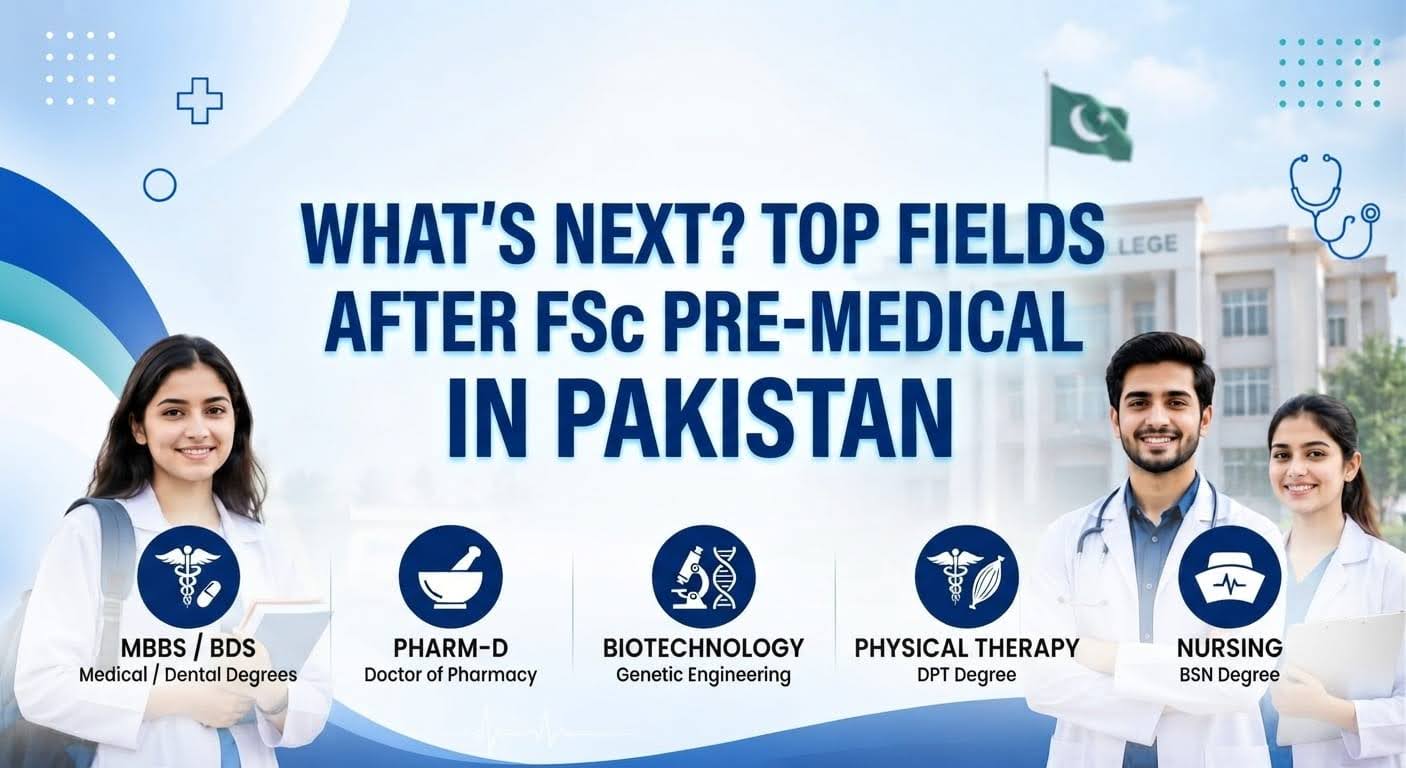
If you are sitting there googling which field is best after fsc pre medical in pakistan, let me save you some time. There is no single perfect answer. It depends on your MDCAT score, your family’s budget, and how patient you are. But this guide will show you every serious medical and healthcare path you can actually take. No coding. No accounting. Just health and healing.
1. MBBS (Bachelor of Medicine and Bachelor of Surgery)
Duration: 5 years + 1 year house job
Entry: MDCAT mandatory + high merit
Cost: Public colleges ~PKR 25,000–50,000/year. Private colleges ~PKR 1.5–3 million/year.
Let us get this out of the way first. MBBS is the dream for most Pre-Medical students. It is also the longest, most expensive, and most competitive route.
If your MDCAT aggregate is above 90% and you can grab a public seat at King Edward, Allama Iqbal, KEMU, RMU, or any public medical college — do it. The degree is subsidized, the training is solid, and the long-term prestige is unmatched. But if you are looking at private medical college with a PKR 10–15 million total bill, think hard. Very hard.
The reality check: MBBS does not make you rich immediately. After 5 years of degree and 1 year of house job, you still need FCPS, MS, or MD specialization (another 4–6 years) before you earn serious money. A fresh MBBS graduate in a government hospital makes less than many other professionals. The wealth comes in your late 30s, not your mid-20s.
Scope: Unmatched long-term. Specialize in surgery, medicine, gynecology, pediatrics, or cardiology and you are set for life. But the road is brutal.
Best for: Students with top MDCAT scores, families who can afford the wait, and people genuinely passionate about clinical medicine.
2. BDS (Bachelor of Dental Surgery)
Duration: 4 years + 1 year house job
Entry: MDCAT mandatory + merit-based
Cost: Public ~PKR 25,000–50,000/year. Private ~PKR 1–2 million/year.
BDS is not a “consolation prize” for missing MBBS. It is a completely different profession with its own massive earning potential. A dentist with a good private practice in Lahore, Karachi, or Islamabad can easily out-earn many MBBS general practitioners.
The key is specialization. Orthodontics, oral and maxillofacial surgery, and implantology are goldmines in urban Pakistan. People will pay ridiculous amounts for a perfect smile and dental implants.
Scope: Excellent for private practice. Lower setup cost than a medical clinic. Faster return on investment. Less emergency duty than MBBS.
Best for: Students who missed MBBS merit by a small margin, have good hand skills, and want a clinical career without the decade-long specialization tunnel.
3. DVM (Doctor of Veterinary Medicine)
Duration: 5 years
Entry: FSc Pre-Medical with 60%+. Some universities require an entry test.
Cost: Public universities ~PKR 30,000–60,000/semester. Private ~PKR 80,000–150,000/semester.
Wait, veterinary medicine? Yes. And do not laugh — Pakistan is an agricultural economy. Livestock is massive. Dairy, poultry, and cattle farming are billion-rupee industries. A good vet is worth their weight in gold to a commercial dairy farm or poultry operation.
UVAS Lahore is the top choice, but PMAS-AAUR Rawalpindi is ranked #2 nationally for veterinary sciences. DVM graduates work in government livestock departments, pharmaceutical companies (animal health division), poultry farms, dairy industries, and wildlife conservation.
Scope: Underrated in Pakistan. Massive abroad — countries like Australia, Canada, and New Zealand actively recruit veterinarians. If you love animals and do not mind the smell of a barn, this is genuinely lucrative.
Best for: Students who love biology but are not obsessed with human medicine. Great scope in rural and agricultural Pakistan.
4. Pharm-D (Doctor of Pharmacy)
Duration: 5 years
Entry: FSc Pre-Medical with 50–60%+. Some universities require entry tests.
Cost: Public ~PKR 20,000–50,000/year. Private ~PKR 80,000–250,000/semester.
Pharm-D is not about standing behind a counter counting tablets. Hospital pharmacists, clinical research associates, drug regulatory officers, and pharmaceutical industry executives all start here. Pakistan has a massive pharma manufacturing sector — Getz Pharma, Searle, Hilton, AGP, Martin Dow, and dozens of others.
Pharm-D graduates work in:
- Hospital pharmacies (clinical pharmacy)
- Pharmaceutical manufacturing (QA, QC, production)
- Drug regulatory authorities (DRAP)
- Clinical research organizations (CROs)
- Community pharmacy chains
Scope: Strong domestic industry presence. Good for corporate healthcare careers. Less patient interaction than MBBS, more lab and industry work.
Best for: Students interested in drugs, chemistry, and industry. If you want a stable 9-to-5 in healthcare without the chaos of a hospital ward, Pharm-D fits.
5. DPT (Doctor of Physical Therapy)
Duration: 5 years
Entry: FSc Pre-Medical with 50%+. No MDCAT required at most universities.
Cost: Public ~PKR 30,000–60,000/semester. Private ~PKR 80,000–150,000/semester.
DPT is booming in urban Pakistan. Every orthopedic surgeon needs physiotherapists. Every sports team needs them. Every rehabilitation center needs them. Every luxury gym in DHA and Clifton now has a DPT on staff.
The beautiful thing about DPT is that you can open an independent physiotherapy clinic with relatively low investment. No expensive surgical equipment needed — just a proper space, some exercise gear, and your skills.
Scope: High growth in cities. Sports medicine, orthopedic rehab, neurological rehab, and geriatric care are all expanding. You can also work abroad — physiotherapy is on the shortage occupation lists for several countries.
Best for: Students who want a clinical career without the MBBS marathon. Good earning potential within 3–5 years of graduation.
6. BS Nursing (BSN)
Duration: 4 years
Entry: FSc Pre-Medical with 50%+. No MDCAT.
Cost: Public nursing colleges ~PKR 10,000–30,000/year. Private ~PKR 50,000–150,000/semester.
Let us kill the stigma right now. Nursing is not a “lesser” profession. In the developed world, nurses are highly respected, well-paid professionals. And right now, BSN is probably the easiest Pakistani healthcare degree for immigration.
The UK alone recruits thousands of Pakistani nurses every year through the NMC (Nursing and Midwifery Council) registration pathway. BSN + 1–2 years experience + IELTS/OET = work visa. Australia, Canada, Ireland, and Gulf countries are also actively hiring.
In Pakistan, government hospital nurses get regular pay scales, promotions, and pension benefits. It is a government job with job security.
Scope: Unmatched for abroad settlement. Strong domestic government sector. High global demand.
Best for: Students who want to leave Pakistan within 5 years. Also for students who want a stable government healthcare job without the MBBS expense.
7. BS Allied Health Sciences (AHS)
Duration: 4 years
Entry: FSc Pre-Medical with 50%+. No MDCAT for most.
Cost: Public ~PKR 20,000–50,000/semester. Private ~PKR 60,000–120,000/semester.
AHS is the backbone of any hospital. Without these professionals, doctors cannot function. Here are the major AHS fields you can enter:
BS Medical Lab Technology (MLT)
You run the labs. Blood tests, urine analysis, cultures, histopathology. Hospitals cannot diagnose without you. Many MLT graduates eventually open independent diagnostic labs, which can be extremely profitable in dense urban areas.
BS Medical Imaging Technology (MIT / Radiology)
You operate the X-rays, CT scans, MRIs, and ultrasounds. As Pakistan’s diagnostic infrastructure expands, skilled radiographers are in constant demand.
BS Operation Theatre Technology (OTT)
You manage the surgical theater. Sterilization, equipment prep, assisting during surgery. Essential and well-respected in surgical teams.
BS Anesthesia Technology
You assist anesthetists during surgery. Critical role. Good pay in private hospitals.
BS Optometry & Orthoptics
Eye care specialists. Not doctors, but you handle vision testing, glasses prescriptions, and pre/post-op eye care. Scope is massive with Pakistan’s aging population.
BS Audiology & Speech-Language Pathology
Hearing and speech therapy. Underserved field in Pakistan. Huge potential for private clinics.
BS Emergency & Critical Care Technology / BS Cardiac Perfusion / BS Renal Dialysis
Super-specialized AHS roles. These graduates work in ICUs, cardiac surgery units, and dialysis centers. High-stress but high-demand and good pay in private hospitals.
BS Human Nutrition & Dietetics
Clinical nutritionists. You work in hospitals, diabetes centers, weight management clinics, and sports facilities. Growing field as lifestyle diseases explode in Pakistan.
Scope: Essential hospital roles. Low tuition. Many AHS graduates eventually open independent diagnostic centers, dialysis units, or nutrition clinics.
Best for: Students who want to be in hospitals but do not want the MBBS route. Fast entry, practical skills, immediate employability.
8. BS Biotechnology / Microbiology / Biochemistry
Duration: 4 years
Entry: FSc Pre-Medical with 50%+.
Cost: Public ~PKR 15,000–40,000/semester. Private ~PKR 50,000–100,000/semester.
These are research-oriented life sciences degrees. Pakistan’s biotech industry is small, so do not expect a massive job market right after BS. However, these degrees are perfect stepping stones for funded MS and PhD programs abroad.
Germany, Netherlands, Sweden, and Scandinavian countries actively fund biotechnology and microbiology research. Many Pakistani students get full scholarships for MS/PhD in Europe because their research skills are in demand.
Scope: Limited immediate job market in Pakistan. Excellent for higher studies abroad and research careers. Some graduates work in pharmaceutical QA/QC, food safety, or agricultural research.
Best for: Students who love research, are patient, and plan to do MS/PhD abroad. Not ideal if you need immediate income.
9. BS Psychology (Clinical Route)
Duration: 4 years
Entry: FSc Pre-Medical or FA with 50%+.
Cost: Public ~PKR 15,000–35,000/semester. Private ~PKR 50,000–120,000/semester.
Mental health is finally getting attention in Pakistan. Clinical psychologists work in hospitals, rehabilitation centers, schools, and private practice. With an MS or MPhil in Clinical Psychology, you can register with the Pakistan Psychological Association and practice independently.
Scope: Growing rapidly. Therapy culture is expanding in urban Pakistan. Good for private practice. Also recognized abroad for counseling and therapy roles.
Best for: Students interested in mental health, counseling, and therapy. Requires patience — you need at least an MS to practice clinically.
10. BS Public Health / Community Medicine
Duration: 4 years
Entry: FSc Pre-Medical with 50%+.
Cost: Public ~PKR 15,000–35,000/semester.
Public health professionals work in health policy, epidemiology, disease prevention, and community health programs. Especially relevant after COVID — the world realized how important public health infrastructure is.
Scope: NGOs, WHO, UNICEF, government health departments, and international health organizations. Good for students interested in population-level health rather than individual patient care.
Best for: Students interested in health policy, epidemiology, and community work. Often leads to government or NGO careers.
Quick Decision Table (Medical Fields Only)
| Your Situation | Best Field |
| MDCAT 90%+, public seat possible | MBBS |
| MDCAT 75–85%, missed MBBS, want clinical practice | BDS |
| Want to immigrate to UK/USA/Australia fast | BS Nursing |
| Love animals, agriculture, or want abroad options | DVM |
| Want pharma industry / corporate healthcare | Pharm-D |
| Want independent clinic, shorter training than MBBS | DPT |
| Want essential hospital role, low cost, start earning fast | AHS (MLT/MIT/OTT/Anesthesia) |
| Research mind, plan MS/PhD abroad | BS Biotechnology / Microbiology |
| Interested in mental health and therapy | BS Psychology |
| Want population health / NGO / policy work | BS Public Health |
FAQs — The Stuff Every Pre-Medical Student Asks
Absolutely not. Pakistan’s healthcare system runs on nurses, pharmacists, physiotherapists, lab technologists, and radiographers. Without them, doctors cannot function. Every role is respectable if you do it well.
BS Nursing is currently the strongest. The UK, Australia, Canada, and Gulf countries are actively recruiting Pakistani nurses. DPT and MLT are also recognized abroad but nursing has the clearest immigration pathway.
No. Once you enroll in a professional degree, you generally cannot switch to MBBS. If your heart is set on MBBS, take a gap year and improve your MDCAT score instead of enrolling in another degree.
They are completely different. DPT is rehabilitation and physical therapy. MBBS is general medicine and surgery. DPT is shorter, cheaper, and lets you start earning faster. MBBS has higher long-term ceiling but requires 10+ years of training. Neither is “better” — they serve different purposes.
BS Nursing or AHS programs at public universities. Punjab University, KEMU, PMAS-AAUR, and other public institutions charge under PKR 50,000 per year. That is less than private schools charge per month.
After DPT, yes — physiotherapy clinics are common and profitable. After AHS, some fields allow independent practice (nutrition, optometry, diagnostic labs) while others require hospital attachment (anesthesia, OT technology).
No. Pharm-D trains you in pharmacy, pharmacology, and drug therapy. MBBS trains you in diagnosis, surgery, and general medicine. They are parallel professions, not substitutes. A pharmacist cannot prescribe independently like a doctor.
Medical Imaging Technology (Radiology) and Anesthesia Technology tend to pay best in private hospitals. MLT has the best entrepreneurship potential because you can open an independent lab. Nutrition & Dietetics is growing fast with lifestyle diseases.
Yes. DVM requires FSc Pre-Medical. It is a 5-year degree. UVAS Lahore and PMAS-AAUR Rawalpindi are the top choices.
You still have excellent medical career options. Nursing, Pharm-D, DPT, AHS, DVM, biotechnology, and psychology all accept FSc Pre-Medical without MDCAT. Do not waste a year sitting at home.
If you need income quickly, skip MBBS. Go for DPT (open a clinic in 3–5 years), AHS MLT (start working in a lab immediately after graduation), or BS Nursing (government job with regular salary from month one). MBBS takes 10+ years before you earn properly. These fields let you start much sooner.
Final Thoughts
FSc Pre-Medical opens more doors than you think. Yes, MBBS is the crown jewel. But the crown is heavy, expensive, and takes forever to earn. Meanwhile, nurses are moving to London, physiotherapists are opening clinics that earn six figures, pharmacists are running pharma companies, and lab technologists are building diagnostic empires.
If you are still wondering which field is best after fsc pre medical in pakistan, stop looking for a single perfect answer. The best field is the one that matches your marks, your budget, and your patience level. Not the one your neighbor’s son chose.
The worst thing you can do is define your worth by whether you got into MBBS. The second worst thing is forcing your family into debt for a private medical seat when a public nursing or DPT degree would have set you up faster.