
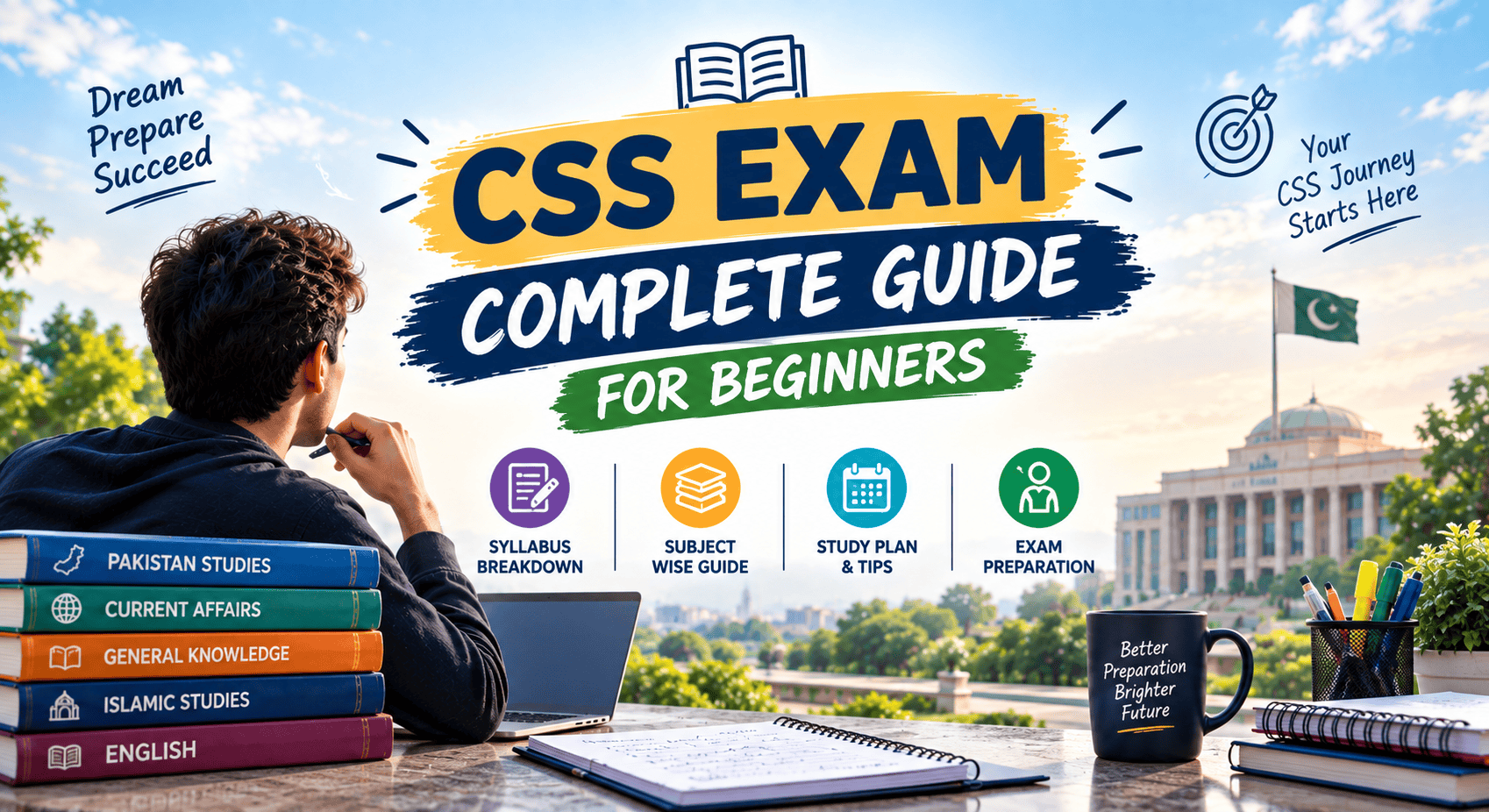
The Central Superior Services (CSS) examination is one of the major competitive examinations in Pakistan. It is conducted by the Federal Public Service Commission (FPSC) to recruit candidates for various posts in the federal government’s civil service occupational groups and services.
For students and graduates who want to pursue a career in public administration, diplomacy, policy, or other government departments, the CSS exam can be an important career pathway. However, preparing for it requires a clear understanding of the eligibility criteria, examination structure, syllabus, application process, and preparation timeline.
If you are planning to appear in the CSS exam for the first time, this guide explains the essential details in simple language and helps you understand how to begin your preparation.
What Is the CSS Exam in Pakistan?
CSS stands for Central Superior Services. It is a competitive examination conducted by FPSC for recruitment to specified federal government posts.
Candidates who qualify through the required examination and subsequent selection stages may be considered for allocation to different occupational groups and services, subject to merit, available vacancies, preferences, suitability, and applicable rules.
The CSS examination assesses candidates’ knowledge, analytical ability, English language skills, general awareness, and understanding of national and international issues.
It is not limited to students who have studied political science or international relations. Graduates from various academic backgrounds can apply if they meet the prescribed eligibility requirements.
Official examination notices, rules, and updates are available on the Federal Public Service Commission website.
CSS Exam Eligibility Criteria in Pakistan
Before beginning preparation, students should confirm whether they meet the eligibility requirements. The main requirements generally relate to nationality, age, education, and the number of attempts.
1. Nationality
Applicants must meet the nationality and domicile requirements prescribed under the applicable CSS rules. Pakistani citizenship is a central eligibility requirement, while specific provisions may apply to candidates from different regions and categories.
Candidates should consult the relevant FPSC advertisement and rules to confirm their eligibility.
2. Age Limit for the CSS Exam
Under the general CSS rules, candidates are ordinarily required to be between 21 and 30 years of age on the prescribed cutoff date, generally January 1 of the examination year.
Age relaxation of up to two years may be available to candidates who fall within specified categories under the applicable rules. It is not automatically available to every applicant.
For example, a candidate’s eligibility depends on their date of birth, the examination year, and whether they qualify for an officially recognised relaxation category.
Always check the current FPSC rules before deciding which examination year to target.
3. Educational Qualification
Candidates generally need at least a bachelor’s degree with at least a second division or Grade C from a recognised university, or an equivalent qualification accepted under the CSS rules.
Applicants with foreign degrees may need to provide an equivalence certificate from the relevant Pakistani authority.
Students who are still completing their degrees should carefully review the qualification requirements and the deadline by which the required result or qualification must be available.
4. Number of CSS Attempts
Under the general rules, candidates are allowed a maximum of three attempts at the CSS written examination, provided they meet the other eligibility conditions.
The attempt rules can be important for beginners because appearing in the written examination may count as an attempt even if a candidate does not pass. Merely applying or appearing in the preliminary screening test does not necessarily have the same effect.
Candidates should read the current rules carefully to understand how attempts are counted and avoid using an attempt without adequate preparation.
What Is the CSS MPT Exam?
The MPT, or Multiple-Choice Preliminary Test, is a screening test introduced as part of the CSS examination process.
Candidates generally need to qualify in the MPT before they can proceed to the written CSS examination. The MPT is a screening stage rather than the final merit examination.
Its main purpose is to assess basic knowledge and understanding across areas such as general knowledge, current affairs, Pakistan affairs, Islamic studies or the relevant alternative subject, English, and quantitative or analytical reasoning, according to the prescribed syllabus.
The test format, marks, qualifying threshold, and application requirements should be confirmed through the relevant FPSC notice for the examination year.
Important: Qualifying the MPT does not mean that a candidate has passed the CSS examination. Candidates must still meet the requirements of the written examination and subsequent assessment stages.
CSS Exam Syllabus and Subjects
The CSS written examination generally carries 1,200 marks, divided into 600 marks of compulsory subjects and 600 marks of optional subjects.
Candidates must choose their optional subjects according to the official subject groups, combinations, and mark requirements. Not every combination is permitted, so students should consult the official syllabus before finalising their choices.
Compulsory Subjects for CSS
The compulsory papers generally include the following subjects:
| Subject | Marks |
| English Essay | 100 |
| English (Precis and Composition) | 100 |
| General Science and Ability | 100 |
| Current Affairs | 100 |
| Pakistan Affairs | 100 |
| Islamic Studies or the applicable alternative subject | 100 |
| Total | 600 |
The alternative subject arrangements for non-Muslim candidates should be checked in the applicable official rules.
English Essay
The English Essay paper assesses a candidate’s ability to develop a coherent argument, organise ideas, and express them clearly in written English.
Candidates should practise writing structured essays, developing arguments with evidence, and maintaining logical flow. Memorising complete essays is not a reliable substitute for learning how to analyse and respond to a topic.
English (Precis and Composition)
This paper tests English comprehension, précis writing, grammar, vocabulary, sentence correction, and related language skills.
Regular practice is important because candidates need to understand passages accurately and express their meaning concisely.
General Science and Ability
This subject covers relevant scientific concepts and analytical or quantitative reasoning. Candidates should study the official syllabus and practise questions that require logical thinking, numerical understanding, and the application of basic scientific knowledge.
Current Affairs
Candidates are expected to understand important national, regional, and international developments. Preparation should include reading reliable news sources, understanding policy debates, and analysing the causes and consequences of major events.
Pakistan Affairs
Pakistan Affairs covers the country’s history, political and constitutional development, geography, society, economy, and contemporary challenges, according to the official syllabus.
Students should focus on understanding historical developments and explaining their relevance rather than relying entirely on memorised facts.
Islamic Studies or the Applicable Alternative
The paper covers the areas specified in the official syllabus. Candidates should study the prescribed topics, develop clear arguments, and support answers with relevant knowledge and examples.
Optional Subjects for CSS
Candidates must select optional subjects totalling 600 marks in accordance with the official subject groups and selection rules.
Available subjects include areas such as:
- Political Science
- International Relations
- Public Administration
- Governance and Public Policies
- History subjects
- Economics
- Sociology
- Psychology
- Geography
- Law subjects
- Computer Science
- Statistics
- Environmental Science
- Regional and foreign languages
This is an illustrative list, not a complete list of all available subjects or a valid combination guide.
The right selection depends on the official subject groups, your academic background, understanding of the syllabus, available study resources, and ability to write analytical answers.
Do not choose optional subjects only because someone claims they are easy or guarantee higher marks. No subject guarantees success in the CSS examination.
How to Apply for the CSS Exam
The application process generally involves several stages. The exact sequence and deadlines are announced by FPSC for each examination cycle.
Step 1: Check the Official Advertisement
Visit the FPSC website and read the latest CSS examination advertisement. Confirm the age limit, qualification requirements, application dates, fee details, and other conditions.
Step 2: Register for the MPT
If the examination cycle requires the preliminary screening test, complete the online application according to the official instructions.
Enter your personal and educational information carefully. Errors in names, dates of birth, qualifications, or other details may create problems later.
Step 3: Prepare for and Qualify the MPT
Study the prescribed MPT syllabus and practise relevant multiple-choice questions. Check the official result and follow the instructions for candidates who qualify.
Step 4: Submit the Written Examination Application
Candidates who qualify for the relevant screening stage must complete the written examination application within the announced deadline and fulfil the documentary and fee requirements.
Read the advertisement carefully because the screening result alone does not complete the written examination application process.
Step 5: Prepare and Appear in the Written Examination
Candidates must prepare for all compulsory and selected optional papers and follow the examination schedule, centre instructions, and document requirements issued by FPSC.
Step 6: Complete Subsequent Selection Stages
Candidates who qualify in the written examination may proceed to the next stages, which can include medical examination, psychological assessment, and viva voce, according to the applicable process.
Final allocation depends on the relevant rules, merit, vacancies, preferences, and other applicable conditions.
CSS Exam Timeline: From Application to Final Selection
The CSS process can extend over a substantial period. The exact calendar varies from one examination cycle to another, so candidates should use the official FPSC schedule rather than relying on dates from previous years.
| Stage | What Happens |
| Official announcement | FPSC publishes the relevant examination notice and schedule. |
| MPT application | Eligible candidates submit applications for the screening test. |
| MPT examination | Candidates appear in the preliminary screening test. |
| MPT result | FPSC announces the result and identifies qualifying candidates. |
| Written application | Eligible candidates complete the required written examination application. |
| Written examination | Candidates sit the compulsory and optional papers. |
| Written result | FPSC announces the written examination result. |
| Further assessments | Candidates who qualify proceed through the applicable assessment stages. |
| Final merit and allocation | Successful candidates are considered under the relevant merit and allocation rules. |
The interval between these stages can vary. Candidates should check the official notices regularly and avoid planning around unconfirmed dates.
How to Prepare for the CSS Exam as a Beginner
CSS preparation can feel overwhelming because the syllabus is broad and the examination requires both knowledge and strong writing skills. A structured study plan helps beginners manage their time and track progress.
1. Read the Official Syllabus First
Download the current CSS syllabus from FPSC and review every compulsory and optional subject.
Identify the major topics, the areas you already understand, and the subjects that require more attention. This will help you develop a realistic preparation plan.
2. Improve Your English Writing
English Essay and English (Precis and Composition) are important parts of the written examination.
Practise writing essays, précis, comprehension answers, and grammatically correct sentences. Ask a knowledgeable teacher or study partner to review your work and identify recurring mistakes.
3. Develop a Current Affairs Routine
Read reliable national and international news sources regularly. Focus on understanding major issues, their background, the stakeholders involved, and their possible effects.
Maintain concise notes organised by topic. For example, you could create separate sections for Pakistan’s economy, foreign relations, climate change, education, governance, and international conflicts.
4. Choose Optional Subjects Carefully
Read the official syllabus for each subject you are considering. Review sample questions and past papers to understand the level of analysis and detail expected.
Your academic background can help, but it should not be the only deciding factor. Consider your interest, available study time, command of the subject, and ability to prepare complete answers.
5. Practise Past Papers
Past papers help you understand question patterns, command words, topic coverage, and the level of explanation expected.
Practise answering questions within a fixed time. After each attempt, check whether your answer addresses the question directly, follows a logical structure, and supports its arguments with relevant evidence.
6. Make Revision Part of Your Plan
Avoid studying new material continuously without reviewing what you have already learned.
Use weekly revision sessions, short notes, topic summaries, and timed practice tests. Regular revision can help you identify weak areas before the examination.
A Six-Month CSS Preparation Plan
The following is an example of a six-month study plan for a beginner who has already confirmed their eligibility. It is not an official FPSC timeline, and some candidates may need more time depending on their academic background and preparation level.
| Period | Main Focus |
| Month 1 | Understand the syllabus, review past papers, assess English skills, and select optional subjects. |
| Month 2 | Begin compulsory subjects and establish a current affairs reading routine. |
| Month 3 | Continue compulsory subjects and cover the core topics of optional subjects. |
| Month 4 | Complete major syllabus areas, practise answer writing, and review current affairs notes. |
| Month 5 | Attempt past papers, practise essays, and identify weak topics through timed tests. |
| Month 6 | Revise key material, complete mock examinations, and improve time management. |
This plan should be adjusted according to the official examination schedule. Candidates who are starting with limited English writing skills or unfamiliar optional subjects may need a longer preparation period.
Common Mistakes CSS Beginners Should Avoid
Many candidates spend a great deal of time collecting study materials without building a consistent preparation routine. Avoid these common mistakes:
- Starting preparation without reading the official syllabus.
- Selecting optional subjects based only on rumours about scoring trends.
- Ignoring English Essay and Precis practice until the final months.
- Memorising information without learning how to analyse questions.
- Relying on a single source for current affairs.
- Collecting too many books and notes without completing them.
- Avoiding past papers and timed answer-writing practice.
- Assuming that qualifying the MPT guarantees success in the written examination.
- Following outdated dates or eligibility information instead of current FPSC notices.
A focused study plan, regular writing practice, and consistent revision can make preparation more manageable.
Is the CSS Exam Difficult?
The CSS exam is competitive and requires broad preparation, analytical thinking, effective written communication, and careful time management. Its difficulty can vary depending on a candidate’s academic foundation, language skills, preparation strategy, and familiarity with the syllabus.
There is no guaranteed shortcut to passing. Beginners should focus on understanding the examination requirements, building their knowledge gradually, practising written answers, and assessing their progress through mock tests.
Final Thoughts
The CSS exam offers eligible graduates a route toward careers in Pakistan’s federal civil service. However, the process requires more than memorising facts. Candidates need to understand the syllabus, meet the eligibility requirements, develop strong English writing skills, follow current affairs, and practise answering questions under examination conditions.
If you are a beginner, start by reviewing the official FPSC rules and syllabus. Then assess your strengths, choose optional subjects carefully, and create a preparation schedule that fits the examination calendar.
Most importantly, rely on official announcements for eligibility, application deadlines, examination dates, and selection requirements. A clear understanding of the process will help you prepare with realistic expectations and make informed decisions about your CSS journey.