
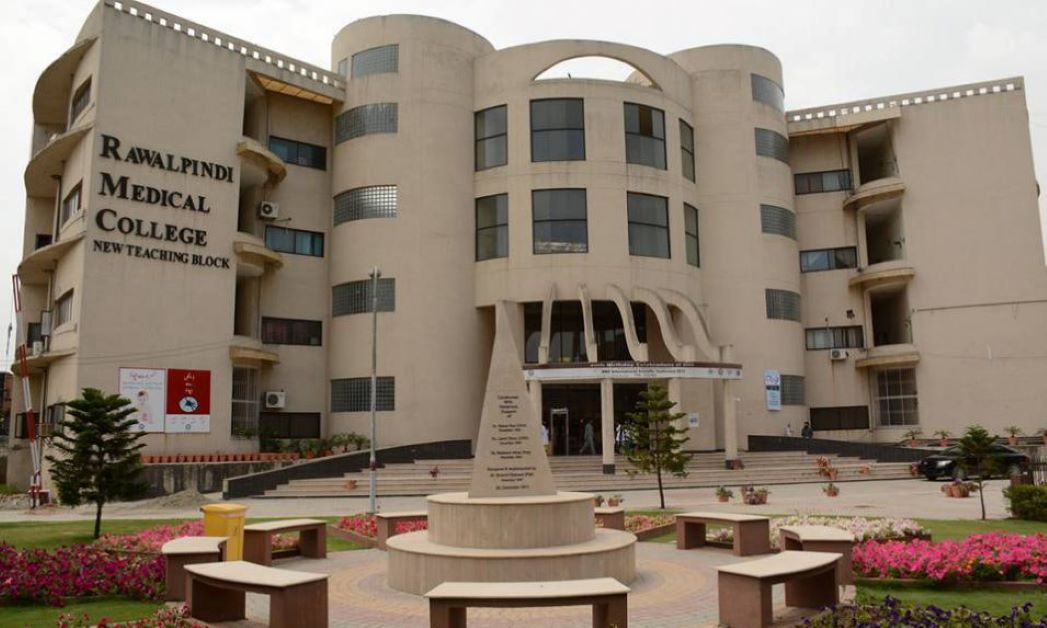
Okay, let us get one thing straight right away. If you are googling “best medical university in Rawalpindi” and expecting some glamorous private campus with a Starbucks and a gym that looks like a hotel spa, RMU is not that. It is not trying to be that. It is a public medical university on Tipu Road that has been training doctors since 1974 (as Rawalpindi Medical College) and finally got upgraded to a full university in 2017. The buildings are old. The corridors are busy. But the doctors who graduate from here? They work in hospitals across Pakistan, the Middle East, Europe, and America.
So yeah. If you want to be a doctor and your dad is not a billionaire, keep reading.
What Is Rawalpindi Medical University Actually?
Rawalpindi Medical University sits on Tipu Road in the middle of Rawalpindi. It is public sector, chartered by the Government of Punjab, recognized by HEC, and regulated by PMDC. It is also affiliated with CPSP for postgraduate training. That is the trifecta you want — HEC for the degree, PMDC for medical practice, CPSP for specialization later.
The university runs four major teaching hospitals:
- Holy Family Hospital — 1,000 beds, established 1948, situated in Satellite Town. This is the big one.
- Benazir Bhutto Hospital — on Murree Road, handles everything from medicine and surgery to eye, ENT, pediatrics, gynecology, orthopedics, urology, and dermatology.
- Rawalpindi Teaching Hospital (DHQ) — serves the inner city, trauma referral center, has neurosurgery, chest diseases, ophthalmology, the works.
- Rawalpindi Institute of Urology Transplant (RIUT) — specialized urology and transplant center.
That is over 3,000 beds of clinical training. For a medical student, that is gold. You are not reading about diseases in a textbook. You are seeing them. All day. Every day.
RMU currently has about 4,123 students (roughly 1,013 male and 3,108 female), 376+ faculty members, and 13,000+ alumni walking around the world saving lives.
Programs: What Can You Study Here?
Undergraduate
MBBS — 5 years. The flagship program. 350 seats. This is what everyone fights for.
Doctor of Physical Therapy (DPT) — 5 years. For those who want to go into rehabilitation and physical medicine.
BS Allied Health Sciences — 4 years. Includes Medical Imaging Technology (MIT), Medical Lab Technology (MLT), Optometry, Orthotics & Prosthetics, and Anesthesia-related programs.
BS Nursing (BSN) — 4 years. Run through constituent nursing colleges at Holy Family, Benazir Bhutto, and DHQ hospitals. The nursing school at Holy Family actually dates back to 1928 when missionaries established it, though the modern structured colleges got PNC accreditation in 2016.
Postgraduate
This is where RMU gets serious. They offer:
- MD / MS Programs — Clinical residency in surgical, medical, and pediatric specialties. Equivalent to specialization.
- MS / MPhil (Master’s) — 2-year programs. Fee is Rs. 400,000 for RMU faculty members and Rs. 500,000 for external candidates.
- Diploma Programs — Diploma in Family Medicine (DFM) and Diploma in Dermatology. Rs. 200,000 each. Require MBBS + one year house job + two years clinical experience.
- Certificate Courses — Shorter specialized training.
- PhD Programs — Research doctorate in medical disciplines.
Heads up: RMU does not offer BDS (Dentistry) at the main campus. If you want dental, look elsewhere.
The Money Talk: What Does It Actually Cost?
Here is the beautiful part.Rawalpindi Medical University is public sector. Which means your taxes (or your parents’ taxes) already subsidize most of it.
MBBS: About PKR 25,000 to 45,000 per year. Not per semester. Per year. For a five-year medical degree, you are looking at roughly PKR 1.5 to 2.5 lakh total in tuition. Compare that to private medical colleges charging PKR 1.5 million per year, and you start to understand why the merit is so high.
DPT & Allied Health: Estimated around PKR 45,000 to 55,000 per semester for DPT, and roughly PKR 35,000 to 48,000 per semester for allied health programs. These are estimates based on public medical university fee patterns — RMU does not always publish a public fee sheet, so confirm at the admin office.
BS Nursing: Around PKR 25,000 to 35,000 per semester. Plus, regular merit seats sometimes come with a stipend. Yes, you read that right — the government might actually pay you a small amount to study nursing. Not a salary, but enough to cover transport and lunch.
Postgraduate Master’s: Rs. 400,000 to 500,000 total for the 2-year program. Diplomas are Rs. 200,000. These are higher because postgraduate medical education is specialized and resource-intensive.
Hostel: Available. Separate for boys and girls. Allocated on distance and merit basis. Not free, but heavily subsidized compared to private hostels in Pindi.
Reality check: These fees are for open merit local seats. Self-finance seats, foreign quota seats, and reciprocal seats have completely different fee structures — usually much higher. If you are applying on anything other than open merit Punjab domicile, call the admin office and ask directly. Do not guess.
Getting In: The Brutal Truth About Merit
Let us not sugarcoat this. RMU is competitive. Very competitive.
MBBS Merit Formula
| Component | Weightage |
| UHS-MDCAT Score | 50% |
| FSc Pre-Medical | 40% |
| Matriculation | 10% |
Minimum requirements: At least 60% in FSc Pre-Medical and a minimum 55% score in MDCAT.
Sounds easy? It is not. Here is the closing merit for recent years:
| Year | Closing Merit (Open Merit) |
| 2024 | 92.32% |
| 2025 | 93.93% |
Yeah. 93.93%. That means if your aggregate is below 93.5%, you are probably not getting in on open merit. You might get in on a quota (disabled, underdeveloped district, etc.), but open merit? Forget it.
To put that in perspective: if you scored 950/1100 in FSc (86.4%) and 180/200 in MDCAT (90%), your aggregate is roughly:
- MDCAT: 180/200 × 50 = 45.0
- FSc: 950/1100 × 40 = 34.5
- Matric: Assume 95% × 10 = 9.5
- Total: 89.0%
That is 4.93% below the 2025 closing merit. You would not get in. You need closer to 1000/1100 in FSc and 190+/200 in MDCAT to feel safe. That is the level we are talking about.
DPT & Allied Health
Minimum 60% in FSc Pre-Medical for DPT. For allied health, some programs accept 50%. These are less competitive than MBBS but still require solid marks. Admission is usually through a departmental entry test or direct merit, depending on the program.
BS Nursing
Minimum 50% in FSc Pre-Medical with Physics, Chemistry, and Biology. Subject to age limits set by the Punjab Nursing Council.
How to Apply (The Actual Process)
For MBBS
This is not handled by RMU directly. All public medical college admissions in Punjab are centralized through the University of Health Sciences (UHS), Lahore. Here is what you do:
- Appear in the UHS-MDCAT and score at least 55%
- Apply on the UHS central admissions portal when it opens
- Upload your FSc marksheet, Matric marksheet, MDCAT result, domicile, and CNIC
- Select RMU as one of your preferred colleges
- Wait for the merit list
- If you make it, confirm your seat and deposit dues at RMU within the deadline
That is it. Rawalpindi Medical University does not conduct separate MBBS admissions. UHS does it for all public medical colleges in Punjab.
For Postgraduate Programs (MD/MS, Master’s, Diplomas)
- Go to rmu.edu.pk and download the application form
- Prepare a bank draft of Rs. 2,000 (non-refundable) payable to “Vice Chancellor RMU Rawalpindi”
- Fill out the form with your personal, academic, and professional details
- Attach:
- MBBS/BDS degree and transcripts
- PMDC registration certificate
- House job completion certificate
- Experience certificates
- CNIC copy
- Recent photographs
- NOC from your employer (if you are already working)
- Submit to the Office of Medical Education R&D Department at Main Campus, Tipu Road, before the deadline
- Wait for the shortlist. Only shortlisted candidates are called for the entrance test or interview.
Postgrad deadline for 2026-27: March 16, 2026, before 2:00 PM. Late submissions are not entertained.
Contact for queries: Phone 051-9330068, Mr. Usama Malik 03355031931, or visit the Office of Medical Education at Tipu Road campus.
Scholarships and Financial Aid
Rawalpindi Medical University is public, so most students do not need massive scholarships. But they are available:
- HEC Need-Based Scholarships — For low-income students. Covers tuition and sometimes a monthly stipend.
- PEEF (Punjab Educational Endowment Fund) — Merit-cum-need scholarships for Punjab domicile holders.
- Zakat and Bait-ul-Mal Grants — Annual tuition waivers for deserving Muslim candidates.
- PM / Chief Minister Laptop Schemes — For top merit achievers.
- RMU Internal Scholarships — The university reports 459+ scholarships currently active.
For postgraduate students, there is less scholarship support. The Master’s and Diploma programs are self-funded. But compared to private medical colleges, even the full fee is manageable.
FAQs — The Stuff Everyone Actually Asks
Public. Fully government-funded. Chartered by the Government of Punjab. Your degree is HEC and PMDC recognized. Do not let anyone tell you otherwise.
No. RMU does not have a dental program at the main campus. For dentistry in Rawalpindi, look at other institutions.
Four major ones: Holy Family Hospital (1,000 beds), Benazir Bhutto Hospital, Rawalpindi Teaching Hospital (DHQ), and Rawalpindi Institute of Urology Transplant (RIUT). Combined, that is over 3,000 beds of clinical training.
93.93% on open merit. In 2024, it was 92.32%. The trend is upward. If you are not scoring above 93%, do not bank on open merit.
Roughly PKR 25,000 to 45,000 per year for open merit local seats. That is not a typo. Public medical education is heavily subsidized in Pakistan. Self-finance and foreign quota seats cost significantly more.
Yes. Separate hostels for male and female students. Allocated based on distance from home and merit position. Apply early if you need it.
No. All public medical college admissions in Punjab are centralized through UHS Lahore. You apply on the UHS portal, not RMU’s. Rawalpindi Medical University only handles admissions for postgraduate, DPT, allied health, and nursing programs directly.
At least 55% in UHS-MDCAT to be eligible. But eligible does not mean admitted. With a 93.93% closing merit, you realistically need 85-90%+ in MDCAT combined with stellar FSc marks to make the list.
Yes. RMU has more than 30 international students currently enrolled. But international seats have different fees and admission procedures. Contact the admissions office directly for details.
MD/MS (specialization), Master’s (M.Phil equivalent), Diplomas in Family Medicine and Dermatology, Certificate courses, and PhD programs. Master’s fees are Rs. 400,000-500,000; Diplomas are Rs. 200,000.
No. The Rs. 2,000 application fee is non-refundable under any circumstances. Even if you are not shortlisted. Even if you change your mind. Gone.
Regular merit nursing seats at constituent nursing colleges sometimes come with a government stipend. It is not a salary, but it helps with daily expenses. Ask the nursing college admin for current stipend rates.
My Honest Take
RMU may not offer a luxurious campus life, but it delivers where it matters most: strong clinical exposure, affordability, and solid postgraduate opportunities.
With four major teaching hospitals and thousands of patients, students gain valuable hands-on experience. The biggest challenge is the extremely high merit, while aging infrastructure and basic facilities may not suit everyone.
Bottom line: If you can secure admission and prioritize quality clinical training over fancy facilities, Rawalpindi Medical University is one of Pakistan’s best-value medical colleges.