
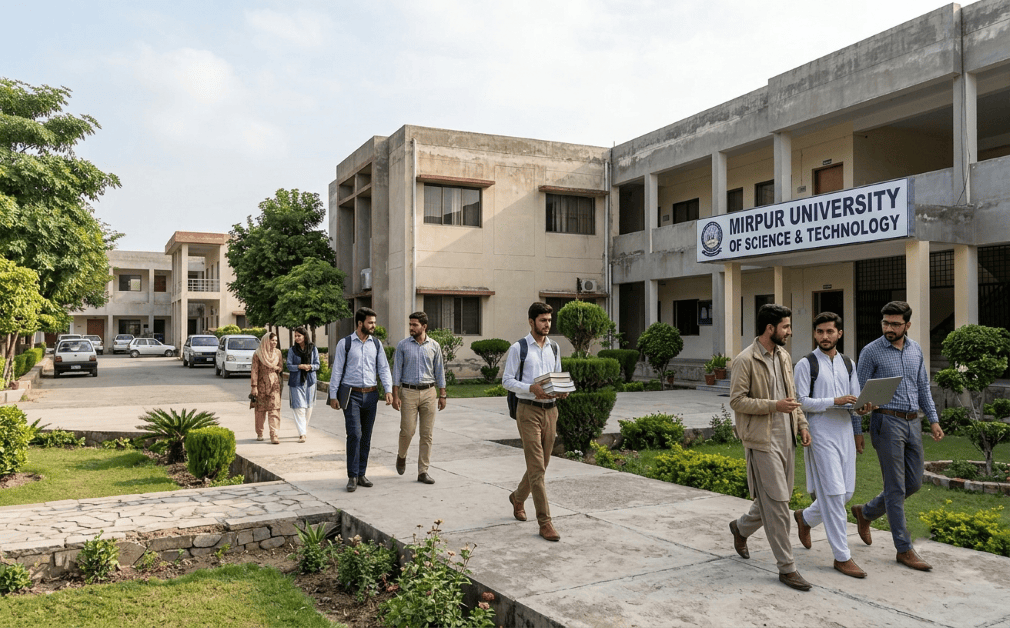
Mirpur University of Science & Technology (MUST) is a public university in Mirpur, Azad Jammu and Kashmir. It came into being in 2008 when the old Mirpur campus of the University of Azad Jammu and Kashmir got upgraded through a Presidential Ordinance.
The place is properly recognized by the Higher Education Commission of Pakistan, and its engineering degrees carry PEC accreditation under the OBE system (Washington Accord style). The computing side also follows the usual professional council standards like NCEAC.
MUST runs a few campuses — main one is the City Campus in Mirpur, plus others including Bhimber and some more spots around AJK. Being a government-funded university, the fees stay on the lower side compared to most private places. There are subsidized seats (especially useful for AJK nationals and refugees) along with open-merit and self-finance options. Students come from AJK, other parts of Pakistan, and even from outside.
Academic Programs You Can Actually Join
Faculty of Engineering & Technology (mostly 4-year B.E. / BS)
Civil Engineering, Electrical Engineering, Mechanical Engineering, Computer System Engineering, Software Engineering, and the technology versions of these (including Artificial Intelligence Technology through Mirpur Institute of Technology).
Faculty of Natural & Applied Sciences (4-year BS)
Computer Science (BSCS), Information Technology (BSIT), Artificial Intelligence, Mathematics, Biotechnology, Botany, Zoology, Physics, Chemistry — the usual science mix.
Faculty of Health & Medical Sciences
Human Nutrition & Dietetics (HND), Medical Lab Technology, and other Allied Health type programs.
Faculty of Management Sciences & Social Sciences / Humanities
BBA, BS Accounting & Finance, BS Banking & Finance, BA-LLB (that one is 5 years), BS English, BS Economics, BS Media & Communication, B.Ed, Islamic Studies, Home Economics and similar programs.
Graduate side
You also get 2-year MS/MPhil and longer PhD research degrees in most of the major departments. Some lateral entry options like BS 5th semester exist in selected fields.
Fee Structure (Rough Idea Per Semester)
Since it’s a public university the cost stays manageable for a lot of students. First semester usually includes those one-time charges (admission fee, security deposit that you get back later, etc.). After that the regular semester dues apply. Numbers change depending on the program, whether you got a subsidized seat or a regular/self-finance one, and the year.
Here’s a rough picture based on what’s been floating around recently:
| Program Field | First Semester (with one-time stuff) | Later Semesters (regular dues) |
| B.E. Engineering (Civil, Electrical, Mechanical etc.) | Around PKR 45,000 – 75,000+ | Around PKR 37,000 – 74,000+ |
| BS Computer Science / Software / BSIT | Around PKR 38,000 – 56,000+ | Around PKR 28,000 – 56,000+ |
| BS Natural Sciences (Biotech, Math, Botany etc.) | Around PKR 32,000 – 51,000+ | Around PKR 25,000 – 51,000+ |
| BS Social Sciences / BBA / BA-LLB | Around PKR 26,000 – 53,000+ | Around PKR 18,000 – 40,000+ |
| MS / MPhil | Around PKR 48,000 – 55,000+ | Varies |
Self-finance seats cost more. Hostel and transport are extra if you need them. There are need-based scholarships for students who qualify. Keep in mind these are approximate numbers — the university updates them, so always check the latest prospectus or the admission portal before you pay anything.
How the Application Process Usually Goes
- Go to the official online admissions system, make an account and register.
- Fill the form with your Matric and Intermediate (or equivalent) marks. If you’re still waiting for results you can still apply provisionally in most cases.
- Generate the challan for the application processing fee.
- Pay that non-refundable fee at the bank they mention.
- If you’re going for engineering or the technology programs, you also have to register for the State Engineering & Engineering Technology Entry Test (SEET) on their separate portal.
- Upload the paid challan copy and your documents before the deadline so the application gets locked.
- Give the SEET if required, keep an eye on the merit lists, pay the admission fee when selected, and get your original documents verified.
Basic eligibility is Intermediate (F.Sc Pre-Engineering, Pre-Medical, ICS, DAE or equivalent) with the minimum marks they set for each program. Pre-Medical students can sometimes get into certain engineering seats under the PEC rules.
Frequently Asked Questions
Yes. HEC recognizes the university. Engineering programs have PEC accreditation under the OBE system, so the degrees are valid.
Only for engineering and the related technology programs you need SEET. Other programs follow whatever criteria they announce for that intake.
No. Subsidized seats (mostly for AJK people and refugees) are cheaper. Regular and self-finance seats cost more. It also depends on the program and the year.
Yes, anyone can apply. AJK nationals and refugees get preference on some subsidized seats, but open-merit seats are there for others too.
Everything — current fees, exact last dates, seat numbers, program lists — needs to be checked on the official university website and the latest admission notices because these things keep changing.
That’s the full picture based on what’s publicly available and official as of early September 2026. Things like fees, deadlines and exact seat plans can shift, so treat the official MUST sources as the final word before you apply or transfer any money.