
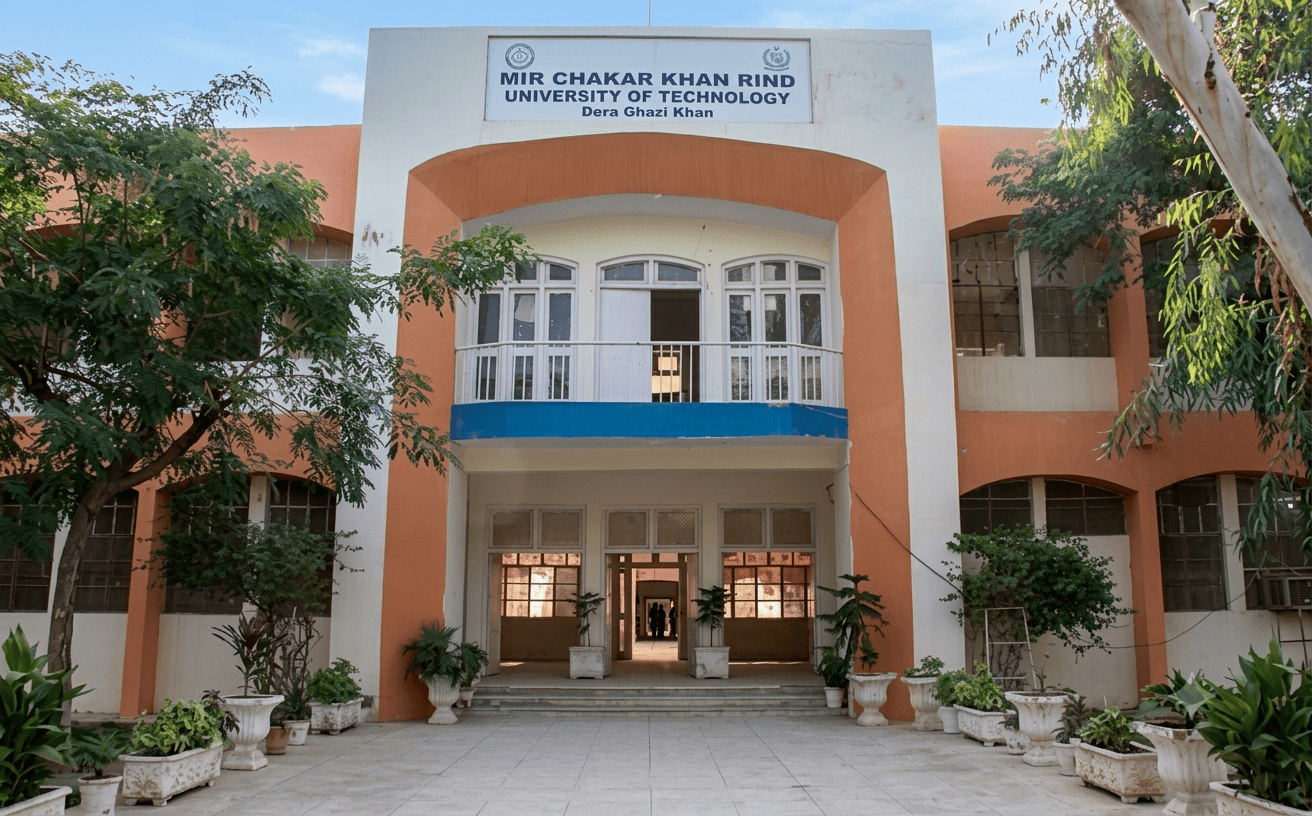
MCUT is a public-sector university on Sakhi Sarwar Road, 12 km from Dera Ghazi Khan city, Punjab. It’s HEC-recognized, chartered by the Government of Punjab, and set up specifically to bring technical and computing education to South Punjab — a region that had almost no local option before this.
It’s co-educational with one shared campus. The university is still young (founded 2019), so it’s growing fast — new departments keep getting added almost every year.
Programs and Degrees at MCUT
This is one of the widest program lists you’ll find in a regional public university. Organized by faculty:
Faculty of Computing & Information Technology
- BS Computer Science, BS Software Engineering, BS Information Technology, BS Artificial Intelligence, BS Cyber Security, BS Data Science, BS Internet of Things
- DAE Computer & Information Technology (2-year diploma), ADP Computer Science (2-year)
- BS Computer Science 5th-semester entry (2-year lateral pathway for DAE/ADP holders)
Faculty of Engineering and Technology
- BS Electrical, Civil, Mechanical, Chemical, Petroleum, Renewable Energy, and Architectural Engineering Technology
- BS Cyber Security Engineering Technology, BS Biomedical Engineering Technology
- BS Medical Laboratory Technology, BS Radiology & Imaging Technology, BS Optometry, BS Health Care Management
- BS Food Science & Technology, BS Environmental Sciences, BS Water Resource Management, BS Disaster Management, BS Remote Sensing & GIS
- Matching DAE diplomas (2-year) in Mechanical, Electrical, Electronics, Civil, Chemical, and Petroleum technology
Faculty of Business Science and Humanities
- BS Business Administration, BS Accounting & Finance, BS Public Administration, BS Project Management, BS Media Sciences, BS Digital Marketing, BS Entrepreneurship, BS Psychology, BS Fashion & Design
One thing worth flagging: most of these are “Technology” degrees, not straight engineering degrees. That distinction matters for PEC (Pakistan Engineering Council) registration — check with the relevant department before you assume a BS Engineering Technology gets you the same license path as a BSc Engineering degree.
Fee Structure at MCUT
Straight from the official fee schedule — this is per-semester, not a one-time total:
| Program Category | 1st Semester (PKR) | 2nd Semester Onward (PKR) |
| Computing & IT (CS, SE, IT, AI) | 28,000 | 24,000 |
| Engineering Technology (Electrical, Civil, Mechanical, Chemical, Petroleum, Renewable Energy, Architecture) | 36,000 | 32,500 |
| Allied Health Sciences (MLT, Radiology) | 46,000 | 42,500 |
A degree runs 8 semesters, so rough math for a computing degree: 28,000 + (24,000 × 7) = around Rs. 1,96,000 total. Engineering technology lands near Rs. 2,63,500. Allied health is the priciest, around Rs. 3,33,500.
Payments go through an online challan per semester — no installment plan, but you’re also not paying it all upfront. Fees do get revised, so double-check the official fee page before budgeting.
Admissions Information & How to Apply
Eligibility differs by program:
- Computing, engineering, and technology programs: FSc Pre-Engineering/Pre-Medical, ICS, or DAE with minimum 50% marks.
- Business, management, and interdisciplinary programs: Intermediate or A-Level with minimum 45% marks.
- Medical Lab Technology & Radiology: FSc Pre-Medical with minimum 50% marks.
Application steps:
- Register an account on the MCUT admission portal.
- Log in and read the eligibility criteria for your chosen program.
- Fill personal details and academic marks (Matric and Intermediate).
- Pick your program and quota — open merit, DAE quota, tribal area quota, or others.
- Enter entry test details: UET ECAT score if you already have one, or register for the in-house MCUT Test if you don’t.
- Generate and pay the processing fee challan (bank, Easypaisa, or JazzCash).
- Submit the form online and print the final PDF along with your paid receipt.
So yes — MCUT does run its own entry test for candidates without a UET ECAT score, mainly for engineering and computing programs. Business and interdisciplinary programs typically skip this and go on merit alone.
Admissions for the current cycle were extended till mid-September — always check the official admissions page since dates shift each intake.
Scholarships at MCUT
MCUT participates in the standard government scholarship network:
- Ehsaas Undergraduate Scholarship Program (HEC-funded): covers full tuition plus a monthly stipend, for students whose family income falls below the set threshold.
- HEC Need-Based Scholarship: for financially deserving students already enrolled.
- BEEF Scholarship (Balochistan Education Endowment Fund): merit-linked support for eligible students from the wider region.
- Internal fee concessions through the university’s own financial aid setup, reviewed each semester.
None of these are unique to MCUT — they’re the same national and provincial schemes most public universities plug into — but the fact that MCUT is registered with all of them means students here have real options if money’s tight.
Campus Life & Culture
Dera Ghazi Khan isn’t a big student city compared to Lahore or Multan, and MCUT sits a bit outside town on Sakhi Sarwar Road — you’ll likely need transport or a nearby rental if you’re not local. The university mentions on-campus medical facility, a library, and a transport service on its site, though detailed hostel information isn’t published — call the admission office directly if boarding is a dealbreaker for you.
Being an engineering-and-technology-focused university, labs matter a lot here. It’s still building out its infrastructure since it’s barely six years old, so don’t expect the depth of equipment you’d see at an older engineering university — but the sheer range of new-economy programs (AI, Data Science, Cyber Security, IoT) is genuinely rare for a public university outside the big cities.
Career paths: CS/IT/AI grads generally head into local software houses, freelancing, or government IT roles. Engineering technology grads often go into industrial and field roles in construction, power, or oil and gas — DG Khan itself has cement and oil-related industry nearby. Allied health grads (MLT, Radiology) work in hospitals and diagnostic labs across South Punjab. No official starting-salary figures are published, so treat anything you find elsewhere as an estimate.
How it compares: Ghazi University, also in DG Khan, is the older, more general public university in the same city — better if you want humanities or pure sciences instead of technology-focused degrees. Bahauddin Zakariya University in Multan is a bigger, more established option an hour away, with a longer track record and broader postgraduate research. MCUT wins if you specifically want computing, AI, or engineering technology without leaving the DG Khan area.
FAQs
Yes, it’s a chartered public-sector university recognized by the Higher Education Commission of Pakistan.
Yes, for most engineering and computing programs. You can use an existing UET ECAT score or sit the university’s own MCUT Test.
It varies by intake — the current cycle was extended into mid-September. Always confirm on the official admissions page.
Roughly Rs. 1,96,000 total for computing programs, Rs. 2,63,500 for engineering technology, and about Rs. 3,33,500 for allied health sciences over 8 semesters.
Ehsaas Undergraduate Scholarship, HEC Need-Based Scholarship, BEEF Scholarship, and internal fee concessions reviewed each semester.
Yes, it’s a co-ed public university with one shared campus.
Not clearly published on the official site — contact the admission office for current boarding arrangements.
Phone: +92 333 4785419. Email: info@mcut.edu.pk. Address: 12 KM, Sakhi Sarwar Road, D.G. Khan, Punjab.