
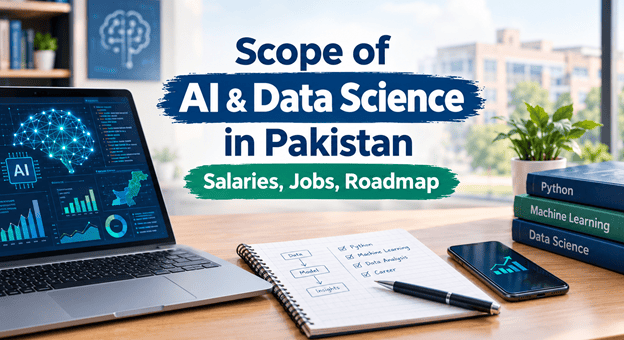
Artificial Intelligence (AI) and Data Science are among the fastest-growing technology fields in Pakistan. From software houses and banks to healthcare, e-commerce and telecommunications, organisations are increasingly using data and AI-based tools to make decisions and automate tasks.
For students, the bigger question is not just whether AI and Data Science have scope in Pakistan. It is what to study, which skills employers want, what jobs are available, and how much a beginner can realistically earn.
What Is the Scope of AI and Data Science in Pakistan?
The scope of AI and Data Science is growing as Pakistani businesses move towards digital systems and data-driven decision-making.
Artificial Intelligence focuses on building systems that can perform tasks that normally require human intelligence, such as understanding language, recognising patterns, making predictions and generating content.
Data Science focuses on collecting, cleaning, analysing and interpreting data to find useful information and support business decisions.
The two fields overlap, but they are not exactly the same.
A data scientist may analyse customer data to predict which products are likely to sell, while an AI engineer may build a machine learning model that makes those predictions automatically.
Students with strong skills in programming, statistics, mathematics and problem-solving can find opportunities across several industries.
AI and Data Science Jobs in Pakistan
The Pakistani technology sector offers different career paths for graduates and skilled professionals.
Some common AI and Data Science jobs in Pakistan include:
| Job Role | Main Work |
| AI Engineer | Builds and deploys AI systems and applications |
| Machine Learning Engineer | Develops and improves machine learning models |
| Data Scientist | Uses data to identify patterns and make predictions |
| Data Analyst | Analyses data and prepares useful reports |
| Data Engineer | Builds systems for collecting and processing data |
| NLP Engineer | Works with systems that understand human language |
| Computer Vision Engineer | Develops systems that process images and video |
| Business Intelligence Analyst | Uses data to support business decisions |
| AI Researcher | Works on advanced AI models and research |
| Generative AI Developer | Builds applications using modern generative AI models |
The exact responsibilities can overlap between companies. A smaller company may also expect one employee to handle several areas.
AI and Data Science Salary in Pakistan
Salary is one of the biggest questions students have before choosing a technology degree.
There is no single AI salary in Pakistan because earnings depend on experience, technical skills, company, city, job role and whether the person works locally or for an international employer.
As a broad market guide, entry-level technology professionals may start around PKR 50,000 to PKR 100,000 per month, while skilled professionals with several years of experience can earn PKR 150,000 to PKR 400,000+ per month.
Specialists with strong machine learning, cloud, software engineering or generative AI skills can earn considerably more, particularly when working for international companies or through remote employment.
For data science salary in Pakistan, entry-level roles may be around PKR 60,000 to PKR 120,000 per month, while experienced data scientists and specialists can move beyond PKR 200,000 to PKR 400,000+ per month.
These figures are indicative rather than fixed salary scales. Your portfolio and practical ability can make a significant difference.
Which Skills Are Needed for AI and Data Science?
A degree alone isn’t enough to build a strong career in these fields.
1. Python
Python is one of the most important programming languages for AI, machine learning and data analysis.
Start with:
- Variables and data types
- Functions
- Loops
- Object-oriented programming
- File handling
- Libraries and packages
2. Mathematics and Statistics
You don’t need to become a mathematician, but a good understanding of statistics is important.
Focus on:
- Probability
- Descriptive statistics
- Regression
- Linear algebra
- Basic calculus
- Statistical testing
These concepts become much easier when you apply them to real datasets.
3. SQL and Databases
Data professionals regularly work with databases. SQL helps you retrieve, filter, combine and analyse data.
It is one of the most practical skills to learn early.
4. Data Analysis
Learn how to clean and understand data using tools such as:
- Pandas
- NumPy
- Excel
- Matplotlib
- Power BI or similar business intelligence tools
5. Machine Learning
Once your programming and data skills are solid, move into machine learning.
Learn concepts such as:
- Supervised learning
- Unsupervised learning
- Classification
- Regression
- Clustering
- Model evaluation
- Feature engineering
6. AI and Deep Learning
Students who want to specialise in AI can later study:
- Neural networks
- Deep learning
- Computer vision
- Natural language processing
- Generative AI
- Large language models
Don’t rush into advanced AI before learning the basics. Strong fundamentals will make advanced topics much easier.
AI and Data Science Career Roadmap
If you’re starting from zero, follow a gradual AI career roadmap rather than trying to learn everything at once.
Step 1: Learn Programming
Start with Python and basic programming concepts.
Build small projects instead of watching tutorials continuously.
Step 2: Learn Mathematics and Statistics
Study the mathematical concepts used in data analysis and machine learning.
You don’t need to memorise formulas without understanding them. Focus on how each concept is used.
Step 3: Learn SQL and Data Analysis
Work with real datasets and practise cleaning, filtering and visualising information.
Step 4: Learn Machine Learning
Study basic algorithms and understand how models are trained, tested and evaluated.
Step 5: Build Projects
This is where many students fall behind.
Create projects such as:
- House price prediction
- Customer churn prediction
- Sales forecasting
- Sentiment analysis
- Recommendation systems
- Image classification
- Student performance analysis
Put your projects on GitHub and explain what you built, which tools you used and what the results were.
Step 6: Choose a Specialisation
After learning the fundamentals, decide whether you want to move towards:
- Machine learning
- Generative AI
- Data Science
- Data Engineering
- NLP
- Computer Vision
- Business Intelligence
Step 7: Apply for Internships and Jobs
Don’t wait until you feel that you know everything.
Apply for internships, junior roles and freelance projects once you have enough practical skills to demonstrate your ability.
Is AI and Data Science a Good Career in Pakistan?
It can be a good career choice for students who genuinely enjoy technology, mathematics, programming and problem-solving.
However, it shouldn’t be selected simply because AI is popular.
The field requires continuous learning. Tools, frameworks and AI technologies change quickly, so professionals need to keep updating their skills.
Students who dislike programming or quantitative subjects may find the learning curve difficult.
AI vs Data Science: Which Is Better?
Neither field is automatically better.
Choose AI if you’re interested in programming, machine learning, intelligent systems, automation and building AI-powered products.
Choose Data Science if you enjoy statistics, data analysis, business problems, visualisation and extracting insights from large datasets.
There is also considerable overlap. A data scientist may use machine learning, while an AI engineer may work extensively with data.
Scope of AI and Data Science for Freelancing and Remote Jobs
AI and Data Science can also provide opportunities beyond traditional office jobs.
Professionals can work on:
- Data analysis projects
- Machine learning models
- AI automation
- Chatbot development
- Data visualisation
- Predictive analytics
- AI-powered applications
- Research projects
Remote work can also allow Pakistani professionals to work with international clients and companies.
However, international income should not be treated as guaranteed. Communication skills, portfolio quality, technical expertise, payment methods and the ability to work with international teams all matter.
What Degree Should You Choose?
Students can enter this field through degrees such as:
- BS Artificial Intelligence
- BS Data Science
- BS Computer Science
- BS Software Engineering
- Related mathematics or statistics degrees
A BS Artificial Intelligence can provide a more focused route into AI, while Computer Science gives broader computing foundations.
Data Science programmes generally place greater emphasis on statistics, data analysis and machine learning.
When comparing universities, don’t look only at the degree title. Check the curriculum, faculty, computing facilities, practical projects, internships and accreditation where applicable.
Final Advice for Students
The scope of AI and Data Science in Pakistan is promising, but a degree alone won’t guarantee a high-paying job.
Start with programming, mathematics, statistics and data analysis. Then build machine learning skills and work on real projects.
Most importantly, don’t measure your progress by how many courses you’ve completed. Measure it by what you can actually build and explain.
For a student starting today, a strong portfolio, practical skills and continuous learning can be more valuable than simply collecting certificates.