
Right after Matriculation, most science students in Pakistan hit the same fork in the road: FSc or ICS, Pre-Medical or Pre-Engineering. It’s a decision that shapes which universities and degrees you can even apply for later, so it’s worth understanding properly instead of just following whatever your friends picked.
This guide covers what FSc actually is, its full form and meaning, the subject breakdown, total marks, how it compares to ICS, and what career paths open up after each stream.
What Is FSc? Full Form and Meaning
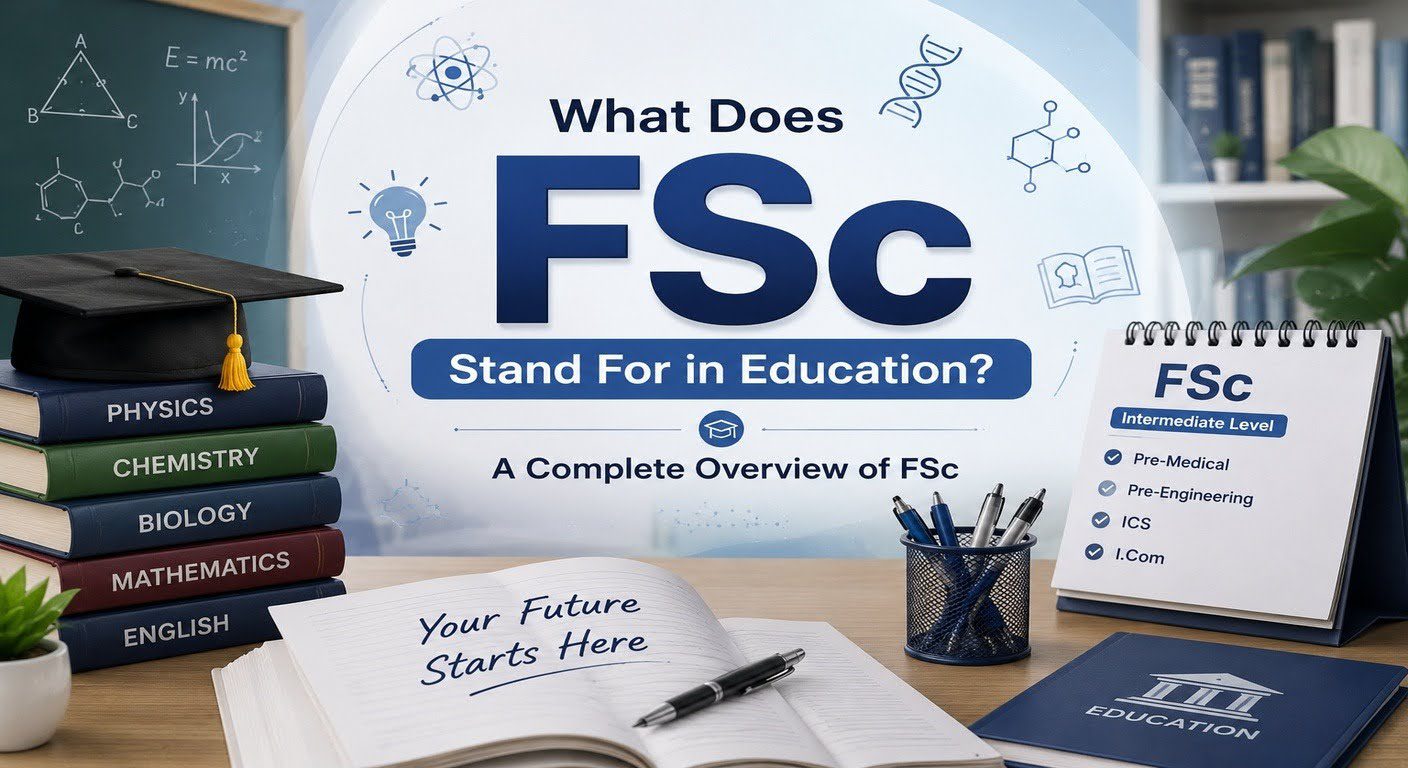
FSc full form: Faculty of Science. That’s the complete answer to “what does FSc stand for” — a two-year Higher Secondary School Certificate (HSSC) program, roughly equivalent to 12th Grade or A-Levels under Cambridge’s international system.
FSc meaning in Urdu: ایف ایس سی کا مطلب فیکلٹی آف سائنس ہے — یہ میٹرک کے بعد دو سالہ سائنس تعلیمی پروگرام ہے جسے انٹرمیڈیٹ بھی کہا جاتا ہے۔
FSc is governed by regional Boards of Intermediate and Secondary Education — BISE Lahore, BISE Karachi, BISE Rawalpindi, and others — along with the Federal Board (FBISE) for federal institutions and Islamabad.
After Matriculation (Class 9 and 10), students spend two years in FSc, split into:
- FSc Part-1 (Class 11)
- FSc Part-2 (Class 12)
Each part is examined separately, and both results combine to make up your final FSc percentage.
Types of FSc: Pre-Medical vs Pre-Engineering
FSc isn’t one single track — it splits into streams depending on what you want to study afterward. There’s also a lesser-known third option, General Science, though most students go with one of the two main streams below.
FSc Pre-Medical
Built for students aiming at healthcare, pharmacy, and biological sciences.
- Core subject: Biology
- Leads to: MBBS, BDS, Pharm-D, DVM, Nursing, Allied Health Sciences, Biotechnology
FSc Pre-Engineering
Built for students strong in math and interested in physical systems, design, and technical fields.
- Core subject: Mathematics
- Leads to: Mechanical, Electrical, Civil, Software, Mechatronics, Aeronautical, and Chemical Engineering, plus Computer Science and Architecture
FSc Subjects and Total Marks
FSc carries a total of 1100 marks, split evenly across Part-1 (550) and Part-2 (550). If you searched for the exact FSc total marks breakdown, here’s the full table:
| Subject | Category | Marks (Part-1 + Part-2) |
|---|---|---|
| English | Compulsory | 200 (100 + 100) |
| Urdu | Compulsory | 200 (100 + 100) |
| Islamic Studies / Civics (Part-1) | Compulsory | 50 |
| Pakistan Studies (Part-2) | Compulsory | 50 |
| Tarjuma-tul-Quran / Ethics | Compulsory | 100 (50 + 50) |
| Physics (Theory + Practical) | Elective Science | 200 (170 theory + 30 practical) |
| Chemistry (Theory + Practical) | Elective Science | 200 (170 theory + 30 practical) |
| Biology (Pre-Medical) OR Mathematics (Pre-Engineering) | Elective Science | 200 |
| Total | — | 1100 marks |
Two things worth noting on the marks structure:
- For Biology, the 200 marks split into theory and a 30-mark practical component, same as Physics and Chemistry.
- For Mathematics, there’s no practical component — the full 200 marks come from theory papers only (100 per part).
Exact mark distributions can shift slightly by board, so always cross-check your specific BISE’s current scheme of studies before exams.
FSc and ICS: Common Subjects and Key Differences
A lot of students get stuck comparing FSc and ICS common subjects before deciding which to pick. Here’s the breakdown.
What FSc and ICS Share
Both groups take the same compulsory subjects — English, Urdu, Islamiyat, Pakistan Studies, and Tarjuma-tul-Quran — plus Physics as a shared elective.
Where They Differ
| Feature | FSc (Pre-Medical / Pre-Engineering) | ICS (Intermediate in Computer Science) |
|---|---|---|
| Elective subjects | Physics, Chemistry, Biology/Math | Physics, Mathematics, Computer Science |
| Chemistry included? | Yes | No — replaced by Computer Science |
| Engineering eligibility | All engineering branches | Limited to Computer/Software Engineering & CS |
| Medical eligibility | Yes (Pre-Medical stream) | No |
Is FSc Better or ICS?
Depends entirely on what you’re aiming for:
- Go with FSc Pre-Engineering if you want maximum flexibility — it keeps every classical engineering branch (Civil, Mechanical, Electrical) open, plus Computer Science, since Chemistry doesn’t block CS admission anywhere.
- Go with ICS if you’re already certain about Software Development, Data Science, AI, or general IT, and you’d rather skip Chemistry altogether.
Neither is objectively “better” — FSc keeps more doors open, ICS lets you specialize a year earlier.
Which Field Is Best After FSc Pre-Engineering in Pakistan?
If you’re wondering which field is best after FSc pre engineering in Pakistan, here are the fields currently offering the strongest demand:
- Software Engineering & Computer Science — strong job growth, remote/international work options, and a large local tech industry
- Electrical & Electronics Engineering — steady demand in energy, telecom, and defense
- Civil Engineering & Architecture — tied closely to infrastructure and construction growth
- Data Science & AI — growing fast, and open to Pre-Engineering students given the math background
- Mechanical & Mechatronics Engineering — manufacturing, automation, and robotics
Scope After FSc Pre-Medical
Beyond the obvious MBBS/BDS route, Pre-Medical students can also go into Pharm-D, Doctor of Physical Therapy (DPT), Biotechnology, Medical Lab Technology (MLT), and Biomedical Engineering (usually with a math deficiency course required at the university level). You can also explore which field is best after FSc Pre-Medical in Pakistan.
Frequently Asked Questions
FSc stands for Faculty of Science — it’s the higher secondary science track (Class 11 and 12) in Pakistan’s intermediate education system, equivalent to HSSC or A-Levels.
FSc is a two-year, board-administered program that students join after Matriculation. It splits into Pre-Medical and Pre-Engineering streams and forms the standard entry qualification for most science-based bachelor’s degrees in Pakistan.
No. Under standard BISE regulations, FSc requires a mandatory two-year cycle (Part-1 and Part-2) for fresh candidates — there’s no legitimate one-year fast-track. That said, private candidates appearing under composite exam rules, or students retaking papers to improve marks under specific board relaxation policies, should check their particular BISE’s current guidelines, since these vary by board and by year.
No, not directly. The CSS exam, conducted by FPSC, requires a minimum 16-year Bachelor’s degree (BS/BA/BSc) with at least a 2nd Division. FSc is only a 12-year qualification, so you’d need to complete a 4-year BS degree first before you’re eligible to sit CSS.
The FSc Pre-Engineering subjects (also written as FSc pre engineering subjects) are Physics, Chemistry, and Mathematics as the core electives, alongside the compulsory subjects — English, Urdu, Islamic Studies, Pakistan Studies, and Tarjuma-tul-Quran.
Yes. FSc Pre-Engineering students can directly apply for BS Computer Science, BS Software Engineering, and BS Artificial Intelligence at universities across Pakistan, including NUST, FAST-NUCES, and GIKI — Chemistry in your FSc transcript doesn’t block CS admission.