

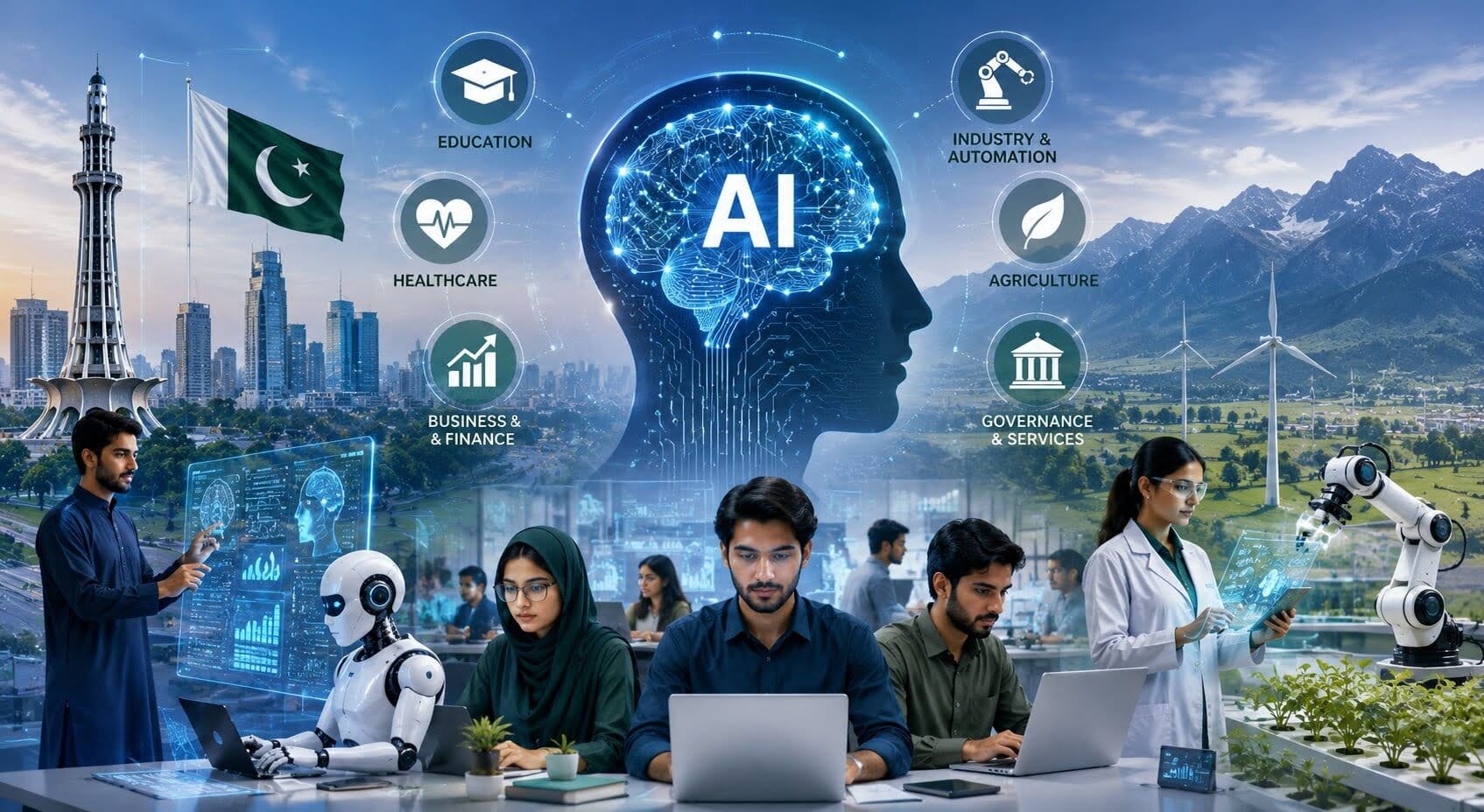
Let’s just get into it. Everyone’s talking about AI right now — your cousin, your LinkedIn feed, that one uncle who watched a YouTube video and now thinks he’s an expert. So naturally, students are asking: what is artificial intelligence scope in Pakistan — is it actually growing, or just hype?
Short answer — the artificial intelligence scope in Pakistan is real and expanding. But no, a degree alone won’t get you anywhere. Keep reading and I’ll break down why.
So What’s the Actual Scope Here?
When people ask about the scope of artificial intelligence in Pakistan, they usually mean one thing: can I actually get a job with this? And the honest answer is — yes, more than a few years ago.
Companies in Pakistan are using AI more than they were even a couple years back. Software houses, banks, e-commerce startups, even some agriculture and healthcare setups — they’re all poking around with AI to automate stuff, detect fraud, analyze customer data, that kind of thing.
Here’s the thing though — you don’t need to work at a company that literally has “AI” in its name. Most AI jobs are inside regular tech companies, where AI is just one part of a bigger product. Think of it like this: a bank doesn’t call itself an “AI company,” but it might have a whole team working on fraud detection models. Same deal everywhere else.
Sectors where this is happening right now:
- IT and software
- Banking and finance
- Healthcare
- Agriculture
- E-commerce
- Education
- Telecom
- Cybersecurity
- Government/public sector (slowly, but it’s happening)
Why Is Everyone Suddenly Into AI?
A few real reasons, not just hype:
The IT industry is growing. Pakistan’s software export game has been picking up, and AI/ML skills are now basically expected on top of regular development skills. Not always required, but it’s a nice edge.
Companies want to automate boring stuff. Nobody wants to manually sort through spreadsheets anymore. AI helps with that — pattern spotting, forecasting, all the repetitive junk that used to eat up hours.
There’s just… more data now. Every business is sitting on piles of customer data, sales numbers, whatever. Someone’s gotta make sense of it, and that’s where AI/data people come in.
Generative AI blew up. ChatGPT and similar tools made everyone AI-aware overnight. Businesses are now experimenting with chatbots, content tools, coding assistants — you name it.
What Jobs Can You Actually Get?
Okay, here’s where students usually zone in. Let’s talk real job titles, not buzzwords.
- AI Engineer — builds and plugs AI/ML models into actual software
- Machine Learning Engineer — trains and deploys models that learn from data
- Data Scientist — mix of stats, coding, and business sense to find patterns in data
- NLP Specialist — works on stuff that understands language — chatbots, text tools, search
- Computer Vision Specialist — teaches machines to “see” — used in medical imaging, security cams, quality checks in factories
- AI Researcher — more academic, usually needs an MS or PhD, works on new models and techniques
- AI Software Developer — regular dev work but with ML/generative AI baked in
Fair warning — titles overlap a LOT. One company’s “AI Engineer” is basically another’s “ML Developer.” Don’t get too hung up on the exact label when job hunting.
Where These Jobs Actually Show Up
Banking — fraud detection, risk scoring, chatbots for customer service. Boring-sounding but decent pay.
Healthcare — medical image analysis, admin automation. To be clear, AI isn’t replacing your doctor. It’s assisting, not diagnosing on its own (at least not yet, not reliably).
Agriculture — yeah, really. Crop monitoring, disease detection, predicting yields, managing irrigation. Underrated space, not many people are looking here yet.
Education — personalized learning tools, tracking student progress, that kind of thing.
E-commerce — recommendation engines (“customers also bought…”), demand forecasting, fraud checks.
Skills That Actually Matter (More Than the Degree Title)
Look, nobody cares if your transcript says “BS Artificial Intelligence” if you can’t code. Here’s what genuinely matters:
Python. Non-negotiable. Learn it properly, not just copy-paste tutorials.
Math. Yeah, I know. But stats, probability, linear algebra, a bit of calculus — this stuff shows up constantly once you get past the basics.
Actual ML understanding. Not just “how to use ChatGPT” — understand how models are trained, tested, and evaluated. There’s a big difference between using AI tools and building them.
Data skills. Cleaning messy data, visualizing it, working with databases. Unsexy but essential — most of the actual work in AI jobs is data cleanup, not the flashy model-building part.
Problem-solving. Sometimes the answer isn’t “use AI.” Knowing when AI is overkill is its own skill.
Is a BS in Artificial Intelligence Even Worth It?
Depends. If you pick a university with a solid curriculum, decent faculty, and actual project/internship opportunities — sure, go for it. A typical AI degree covers programming, data structures, algorithms, stats, ML, deep learning, NLP, computer vision, that whole bundle.
But — and this is important — the degree by itself won’t carry you. I’ve seen this pattern too many times: student graduates, has a nice CGPA, zero real projects, and then wonders why nobody’s calling back for interviews. Meanwhile someone with a mediocre GPA but three solid GitHub projects and one internship gets picked first.
So before choosing a uni, actually check:
- The curriculum (not just the program name)
- Who’s teaching it
- Lab/facility quality
- Internship and industry links
- What kind of final-year projects past students built
Is AI Actually a Good Career Choice in Pakistan?
Honestly? Yeah, if you genuinely enjoy programming, math, and solving problems. Not if you’re chasing it purely because it sounds trendy or because you heard AI engineers make good money.
The students who do well here are the ones stacking:
- Real projects (not tutorial-follow-alongs — actual built things)
- Internships
- Strong programming fundamentals
- ML knowledge that goes past “I used a library once”
- Decent communication skills (yes, this matters more than people think)
Where Is This Headed?
Nobody’s got a crystal ball, but a few trends look pretty safe bets:
- Automation keeps expanding — more businesses handing off repetitive tasks to AI systems
- Generative AI keeps getting baked into regular software — not as a separate flashy product, just quietly built in
- Data + AI combo skills stay valuable — more data means more need for people who can actually use it
- Remote/international work is possible — Pakistani AI talent can compete globally, though heads up, that market is brutal competitive
The Not-So-Fun Part: Challenges
Not gonna sugarcoat this one.
- Not every company has a dedicated AI team. Sometimes it’s one guy doing “AI stuff” as 20% of his actual job.
- Competition is real — you’re not just up against local grads, you’re up against people worldwide applying for the same remote gigs.
- University alone won’t cut it. The practical gap between classroom AI and real-world AI is bigger than most students expect.
- Things move fast. What’s cutting-edge this year might be outdated methodology next year. Constant learning isn’t optional here.
- Compute resources cost money. Serious AI research/model training needs GPUs and infrastructure that isn’t cheap or always accessible locally.
Okay, So How Do You Actually Start?
If you’re serious, here’s roughly the order that makes sense:
- Learn Python properly — not just syntax, actually build small things with it
- Brush up on math — stats and probability first, they show up everywhere
- Learn core machine learning — algorithms, training, evaluation, the whole pipeline
- Build real projects — use actual datasets, not toy examples from a course
- Get an internship — even unpaid or short-term, it teaches you how AI actually gets used in practice
- Pick a lane eventually — ML, NLP, computer vision, generative AI, data science — you don’t need to master everything
- Keep learning, forever — this field doesn’t sit still, and neither can you
Bottom Line
The scope of artificial intelligence in Pakistan is real and it’s growing — banking, healthcare, agriculture, e-commerce, education, all of it. Career paths exist: ML engineer, data scientist, NLP specialist, computer vision, research, AI-integrated dev work.
But don’t walk in thinking the degree alone does the work. It doesn’t. What actually gets you hired is the combo — solid programming, real math, actual built projects, and some hands-on experience. Focus on what you can build and solve, not on how trendy “AI” sounds on your CV.
FAQs
It’s growing across IT, banking, healthcare, agriculture, education, and e-commerce. Career paths include machine learning, data science, AI engineering, NLP, and computer vision.
Yes, if you actually like programming, math, and problem-solving. Not a great fit if you’re only chasing it for the hype.
Looks like it — more businesses are adopting automation, data tools, and generative AI every year. Growth’s happening, just not overnight.
AI Engineer, Machine Learning Engineer, Data Scientist, NLP Engineer, Computer Vision Engineer, AI Researcher, or general AI-focused software development roles.