

Precis writing shows up in almost every Pakistani English exam. FA, FSc, and the CSS English paper all test it. And it trips up a lot of students.
Not because it’s hard to understand. It trips people up because it has strict rules, and even one small mistake costs marks. A precis isn’t just “the passage, but shorter.” It has to be a specific length, written in a specific way, and structured a specific way.
This guide keeps things simple. You’ll learn what a precis actually is, the core rules for FSc, FA, and CSS, a step-by-step method, a full worked example, and the mistakes that cost the most marks.
What Is Precis Writing?
The word “precis” comes from French. It means “precise” or “cut short.”
A precis is a short version of a longer passage. It keeps the main ideas. It drops everything else, examples, repeated points, and decorative language.
Here’s the key difference from a normal summary: a precis has strict rules. An exact word limit. One paragraph only. A required title. A summary is more flexible. A precis is not.
Precis Writing Rules (The Core List)
These rules apply to FSc, FA, and CSS precis writing. Only the passage length changes between them. The rules stay the same.
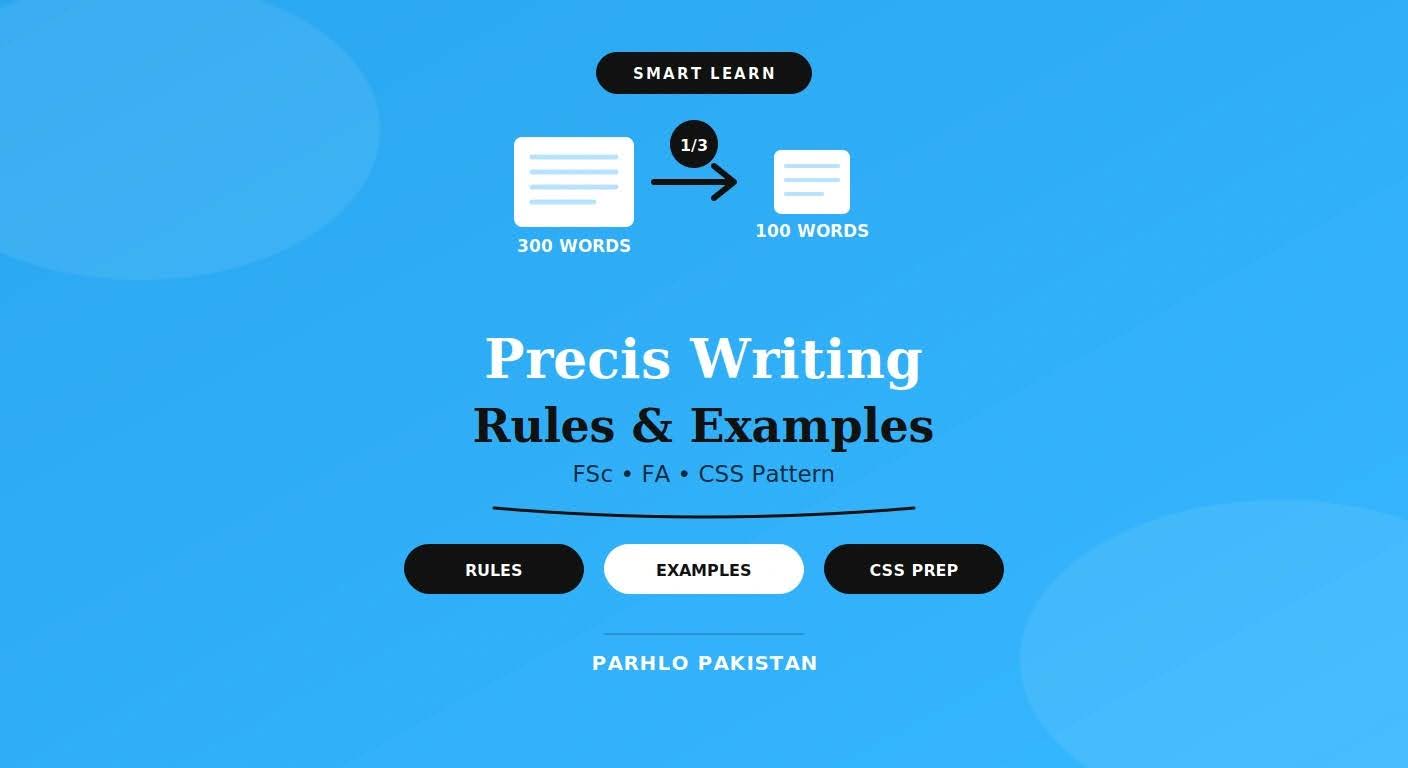
1. Length: about one-third of the original This is the most important precis writing rule. If the original is 300 words, your precis should be close to 100 words. Most exams allow a small margin, usually around 5 words either way. Go too far over or under, and you lose marks, even if your writing is good.
2. Use your own words Don’t copy phrases from the original. Even short ones. Examiners look for this. If you just swap one or two words per sentence, that still counts as copying. Say the same idea, but in your own vocabulary.
3. Write in third person Even if the original says “I” or “we,” your precis should say “the author” or “the writer.” Describe their argument from the outside.
4. Keep the tense consistent Match the tense used in most of the original passage. If it’s mostly present tense, stay present tense. If it’s mostly past tense (common in stories or historical writing), stay past tense. Don’t mix the two.
5. Write one paragraph only No bullet points. No multiple paragraphs. One connected paragraph, using linking words like “however” and “therefore” to keep it flowing.
6. Cut examples, quotes, and figures of speech Metaphors, anecdotes, and quotations support the main point. They aren’t the main point. Remove them and keep only the core idea behind them.
7. No personal opinion A precis reports what the author said. It doesn’t agree, disagree, or add commentary, even if your opinion is reasonable.
8. Add a short title Most precis questions want a title, usually 5 to 8 words. Write your own. Don’t just copy a phrase from the passage.
Precis Writing for FSc and FA Students
In FSc and FA English papers, precis writing is usually a compulsory question. The passage is shorter than what CSS uses.
The same core rules apply: one paragraph, your own words, a short title, no opinions. Board exam passages tend to be simpler than CSS passages. So the real challenge for FSc and FA students isn’t usually understanding the passage. It’s staying disciplined with word count and resisting the urge to copy phrases straight from the text.
Precis Writing for CSS Aspirants
In the CSS English Precis and Composition paper, this question carries real weight. The passages are longer and denser, often 250 to 350 words of formal or argumentative writing.
Examiners are strict here. They check the exact word count. They check for genuine paraphrasing, not just word-swapping. And CSS passages often have several related points, not just one obvious idea, so picking out the single central theme takes more practice. Most successful CSS aspirants write precis regularly, not just once or twice before the exam.
How to Write a Precis: Step by Step
- Read the passage two or three times. Don’t start writing until you actually understand the argument, not just the topic.
- Find the central idea. Ask yourself: if this passage were one sentence, what would it say?
- Note the essential supporting points. Skip examples and anecdotes, they’re not essential.
- Write a rough draft. Focus on getting the ideas right first. Worry about word count next.
- Count your words. Too long? Cut padding and combine sentences. Too short? Check if you missed a key point, don’t just pad it out.
- Write a short title.
- Proofread. Check tense, third-person voice, and grammar. It’s easy to lose marks here after doing the hard part well.
Precis Writing Example (With Word Count)
Original Passage (168 words):
Reading has always been considered one of the most valuable habits a person can develop, yet in the age of constant digital notifications, it is becoming increasingly rare. Many people today find it difficult to sit with a book for even twenty uninterrupted minutes, not because they lack intelligence or curiosity, but because their attention has been trained, gradually and almost invisibly, to expect constant novelty. Social media platforms are designed to reward short bursts of engagement, and over time, this rewires the brain’s tolerance for sustained focus.
The consequences extend beyond reading itself. Deep work, careful analysis, and patient problem-solving all require the same kind of sustained attention that reading demands. When that capacity erodes, it doesn’t just affect how many books someone finishes in a year; it affects the quality of thought they’re capable of in every other area of life. Reclaiming the ability to focus, then, is not simply about becoming a better reader. It is about protecting a mental capacity that modern life is quietly wearing away.
Precis (56 words):
Title: The Erosion of Sustained Attention
The author argues that constant digital stimulation is steadily eroding people’s capacity for sustained focus, making activities like reading increasingly difficult. This decline in attention span extends beyond reading, affecting deep work and careful thought generally. The author concludes that restoring the ability to concentrate is essential not merely for reading, but for preserving overall quality of thought.
(Original: 168 words. Precis: 56 words. That’s almost exactly one-third.)
Common Precis Writing Mistakes
- Copying phrases from the original. Even changing one or two words per sentence still counts as copying, not paraphrasing.
- Wrong word count. Both too long and too short cost marks, even with good writing. Always count, don’t guess.
- Using first person instead of switching everything to third person.
- Mixing tenses partway through the precis.
- Keeping examples or quotes that should have been cut.
- Adding your own opinion, even a reasonable one.
- Forgetting the title, or writing one that’s too long or copied from the text.
- Splitting into multiple paragraphs instead of one connected one.
Precis Writing Checklist
- Length is about one-third of the original, within 5 words or so
- Fully in your own words, no copied phrases
- Third person throughout
- Tense matches the original passage
- Written as one paragraph
- No examples, quotes, or figures of speech carried over
- No personal opinion added
- Has a short, original title
- Word count is written down, if your exam requires it
Frequently Asked Questions
About one-third of the original word count, usually within 5 words either way. If your exam gives you a specific length, follow that instead.
Some overlap is fine, especially names or technical terms. But copying phrases or full sentences is penalized. Paraphrase properly, don’t just swap a word or two.
Always third person. Say “the author” or “the writer,” never “I” or “we,” even if the original passage uses “I.”
Yes, in FSc, FA, and CSS formats. Keep it short, 5 to 8 words, and write it yourself instead of copying a line from the passage.
A precis follows strict rules: a set length (usually one-third), one paragraph, third person, and a title. A summary is more relaxed and doesn’t follow the same fixed format.
Practice regularly, and under timed conditions. Pick a passage of 250 to 350 words, write your precis, then compare it to the original. Check if you missed a key point, accidentally copied a phrase, or got the word count wrong. A few weeks of consistent practice beats reading about the rules alone.