
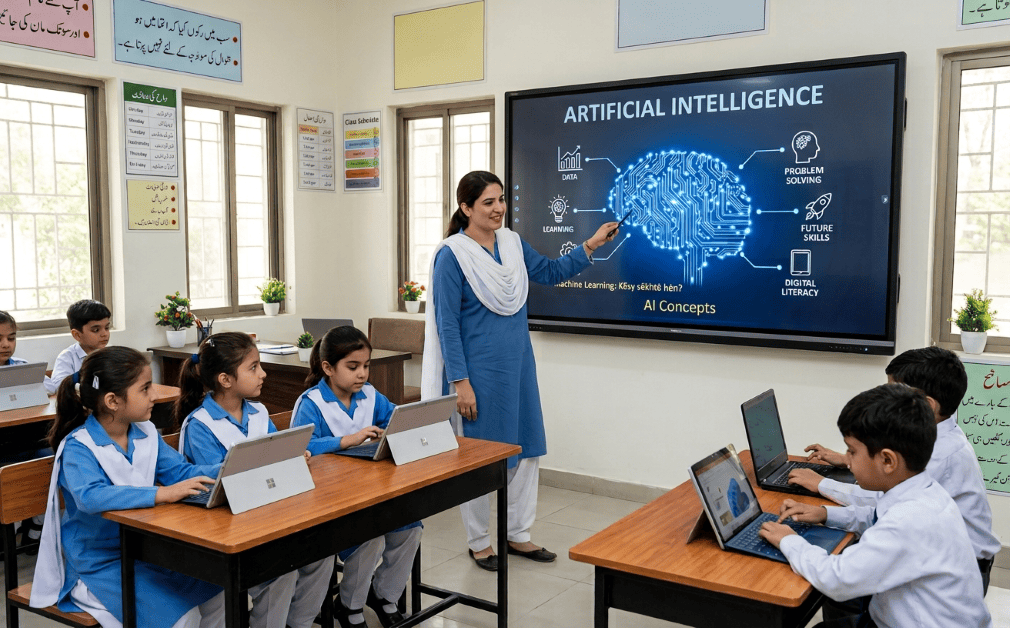
Punjab has made significant strides in modernizing the education sector by creating Pakistan’s first Artificial Intelligence (AI) policy, which has a strong emphasis on equipping students with the skills they need for the evolving digital landscape. The Punjab education minister, Maryam Nawaz Sharif, has decided to introduce AI education in government schools from the first grade, thus providing students with a chance to have access to modern technology at an early age.
The initiative aims to engage students in learning that is relevant and can help them build skills for their future careers in an economy that is increasingly technology based. The move also highlights the growing importance of AI Education in Pakistan and its potential role in transforming the country’s education system.
Punjab Makes AI Education Mandatory from Grade 1
The inclusion of AI education from Grade 1 is a major shift in the school curriculum as students are introduced to this technology at a young age. The Punjab government has not waited for later stages of student education or university for the introduction of basic concepts and awareness of Artificial Intelligence. Instead, it wants to sow this seed at the onset of a child’s learning under the new Punjab AI Policy.
In primary education, AI learning can enable the understanding of technology in an easy and grade-appropriate manner. For students in subsequent grades, the knowledge and skills can be built up to more advanced topics, digital literacy, problem solving and responsible use of Artificial Intelligence tools.
The policy represents a shift in the recognition of the need to include AI education in the mainstream of education and learning rather than restricting it to computer science and specialized university courses.
Why AI Education Is Important in Pakistan
As technology skills become more important everywhere, Pakistan is also heading towards a digital economy. The integration of AI education starting from the school level can empower students to become familiar with technologies that are likely to impact the fields of education, business, healthcare, finance, engineering, and numerous others.
For Pakistan, early exposure to AI can provide several potential benefits:
- Develop digital literacy among school students
- Introduce children to Artificial Intelligence at an early age
- Encourage creativity and problem-solving
- Prepare students for technology-based careers
- Improve awareness of emerging technologies
- Help students understand responsible use of AI
- Support Pakistan’s transition toward a digital economy
This makes AI Education in Pakistan an increasingly important topic for students, parents, teachers and policymakers.
Role of Education Minister of Pakistan and the role of Provincial Education Leadership.
The Federal and Provincial governments are involved in education policies since education is to a large extent under provincial control. Hence, it is essential that such programs like the AI education policy are given special significance in the school education system in the province.
Pakistan’s education minister along with provincial education authorities can play an important role in promoting education reforms which include digital literacy, integration of technology, and development of modern curricula. Punjab’s education leadership level ensures that policies are turned into actual programmes for government schools at provincial level.
But the implementation of the policy will depend as much as on the announcement of it, on the training of teachers, on curriculum development and on the availability of appropriate technology, for the success of AI education will so far depend. AI has the potential to transform school education.AI can revolutionize school education.
Role of the Education Minister of Pakistan
AI can revolutionize the student-teacher relationship and the way students learn. Technology can enable personalized learning, learning resources, assistive technology, and interactive learning experiences.
But, AI education should not just be centered around using AI applications with children. Pupils should also learn the boundaries and good practice of technology. It is important that critical thinking and creativity, as well as independent learning, continue to be integral to the education system.
Thus, a good AI curriculum will be able to integrate fundamental AI concepts with broader digital and analytical abilities.
AI Education and Future Skills.
A key goal of implementing AI Education in Pakistan is to equip students for future jobs. Many industries are increasingly using Artificial Intelligence, automation, data analysis and other digital technologies. If students learn these concepts early on in their academic career, they will have greater base knowledge when they start pursuing careers like computer science, software engineering, data science, robotics, business analytics, and other technologies.
The advent of AI in Grade 1 can then be seen as an investment in human capital over the long term. Education is not just about the jobs of the day; it can start preparing students for the jobs that may be more significant in the future.
Challenges for Government Schools
The adoption of AI education also faces several challenges. However, AI education has its challenges. While the policy is a positive step, the rollout of AI education in government schools will need to be carefully planned. Schools may not be equally equipped with computers, Internet, and other electronic resources.
There will also be a need for teacher training. Teachers require appropriate training to effectively communicate concepts of AI to young learners and a proper set of resources to support them. The curriculum should be tailored to the age and learning capacities of the students.
Key implementation areas include:
- Training teachers to teach AI-related concepts
- Developing age-appropriate AI curriculum
- Providing digital resources to government schools
- Improving computer and internet access
- Ensuring students in different areas receive equal opportunities
- Promoting responsible and safe use of AI
- Regularly updating the curriculum as technology develops
What This Means for Students
For students in Punjab’s government schools, the introduction of AI education from Grade 1 could gradually change the way technology is taught in classrooms. Young learners may begin with basic concepts, while older students can move toward more practical and advanced applications.
The long-term objective is to create students who are not only consumers of technology but also capable of understanding, evaluating and eventually creating technology-based solutions. This approach can also help bridge the digital skills gap by giving students from government schools greater exposure to emerging technologies.
The Future of AI Education in Pakistan
Punjab’s decision could encourage further discussion about the future of AI Education in Pakistan. As Artificial Intelligence continues to influence almost every major sector, education systems will need to evolve accordingly.
The success of the initiative will depend on how effectively the policy is implemented at the school level. A strong combination of curriculum, teacher training, technology infrastructure and responsible AI education can help students develop the skills needed for the future.
The introduction of AI Education from Grade 1 is therefore an important development for Punjab’s education system and could become a model for wider discussions about technology-focused education across Pakistan.