
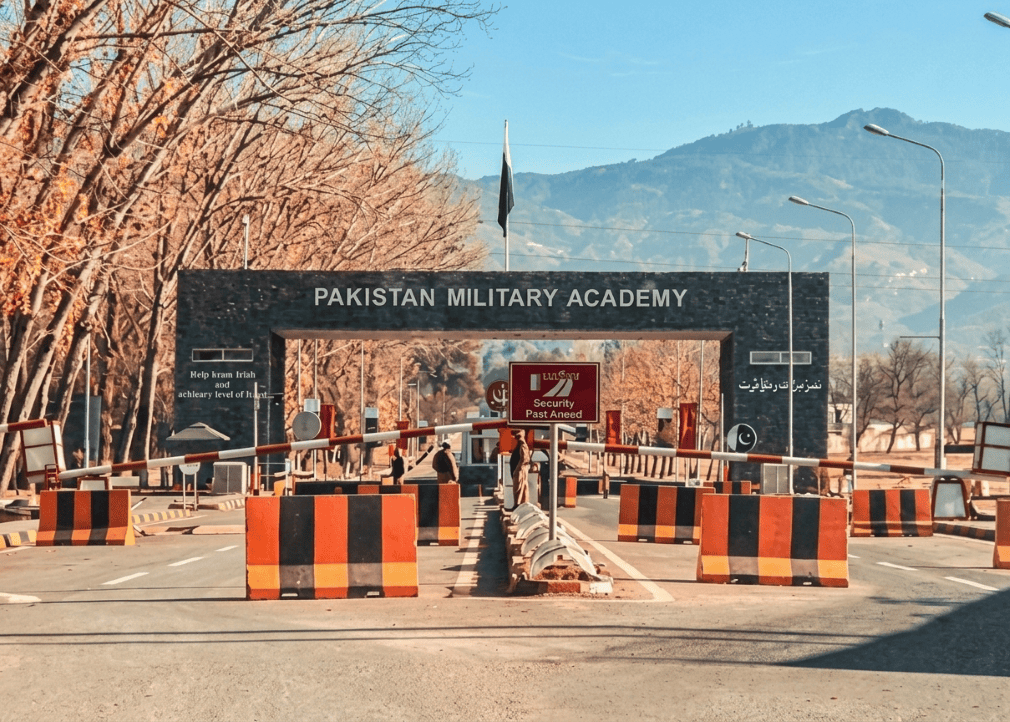
Let us be honest. Every Pakistani student has imagined themselves in that olive green uniform at some point. The Pakistan Army is not just a job here — it is a calling. And the road to that uniform runs through one gate: PMA Kakul in Abbottabad.
Established on November 25, 1947 — just months after independence — PMA is the primary officer training institution of the Pakistan Army. It sits in the foothills of the Himalayas and has trained generations of officers who lead troops from Siachen to the deserts of Sindh.
But here is what the recruitment posters do not tell you: getting in is brutal. Roughly 90% of applicants are filtered out before they ever see the PMA campus. This guide breaks down every course, every eligibility rule, the full selection process, and what life after PMA actually looks like. No movie fantasies. Just facts.
PMA Kakul at a Glance
| Detail | Information |
| Full Name | Pakistan Military Academy |
| Location | Kakul, Abbottabad, Khyber Pakhtunkhwa |
| Established | November 25, 1947 |
| Type | Military Officer Training Institution |
| Affiliation | Pakistan Army, NUST (for BMAS degree) |
| Degree | Bachelor of Military Art and Science (BMAS) — HEC recognized |
| Website | joinpakarmy.gov.pk |
Courses at PMA: Which Route Fits You?
PMA is not one-size-fits-all. The Army has built multiple entry routes depending on your education, age, and gender. Here is every option currently open.
1. PMA Long Course (LC)
Who it is for: Male civilians and serving soldiers who want to become regular commissioned officers.
| Requirement | Details |
| Education | FSc / FA / ICS / A-Levels (minimum 2nd Division) |
| Age | 17 to 22 years (civilians); 17 to 23 years (serving soldiers); 17 to 24 years (GD Pilots) |
| Height | Minimum 5 feet 4 inches (162.5 cm) |
| Training | 2 years (4 terms) at PMA Kakul |
| Commission | Second Lieutenant |
| Degree | BMAS (Bachelor of Military Art and Science) via NUST |
This is the classic route. You apply as a civilian, pass the tests, and spend two years being transformed from a regular student into an Army officer. The BMAS degree is awarded in affiliation with NUST and is HEC-recognized, so you are getting a proper university degree alongside military training.
2. Technical Cadet Course (TCC)
Who it is for: Male students with an engineering background who want to join as technical officers.
| Requirement | Details |
| Education | FSc Pre-Engineering or ICS with 60–65% marks |
| Age | 17 to 21 years |
| Height | Minimum 5 feet 4 inches |
| Training | 4 years at NUST + 1 year at PMA Kakul |
| Commission | Captain |
| Degree | BE / BSc Engineering from NUST |
TCC cadets study engineering at NUST for four years as civilian students, then do their final year of military training at PMA. They commission as Captain — one rank higher than Long Course graduates. They serve in the Corps of Engineers, Signals, Electrical and Mechanical Engineers (EME), and other technical arms.
3. Integrated Course (IC)
Who it is for: Doctors, dentists, and specialists who want to join as medical officers.
| Requirement | Details |
| Education | MBBS / BDS / Specialized Master’s degrees |
| Age | Up to 28–30 years depending on specialization |
| Training | 6 months at PMA Kakul |
| Commission | Captain (MBBS/BDS) or Major (specialists) |
Doctors and dentists do not need two years of basic training. They get a condensed 6-month course that teaches leadership, military customs, and officer functions. Then they are posted to military hospitals and field medical units.
4. Lady Cadet Course (LCC)
Who it is for: Qualified female professionals who want to serve as officers.
| Requirement | Details |
| Education | BS / Master’s degree in relevant fields |
| Age | 21 to 28 years depending on corps |
| Training | 6 months at PMA Kakul |
| Commission | Captain |
| Fields | Medical, Dental, Education, Legal, Software Engineering, and other specialized corps |
LCC is the primary route for women to join the Pakistan Army as officers. Unlike the Long Course, LCC candidates are already professionals — doctors, engineers, teachers, lawyers, IT specialists. The 6-month training teaches them to function as officers in their respective fields.
PMA Admission Eligibility
| Course | Education | Age | Height |
| Long Course | FSc/FA/ICS/A-Level (2nd Div) | 17–22 (civilians) | 5’4″ |
| TCC | FSc Pre-Eng/ICS (60–65%) | 17–21 | 5’4″ |
| Integrated Course | MBBS/BDS/Master’s | Up to 28–30 | Standard |
| Lady Cadet Course | BS/Master’s | 21–28 | Standard |
Important medical notes:
- Eyesight standards vary by branch. GD Pilots need perfect vision. Other arms allow glasses within limits.
- Tattoos are not allowed — automatic medical rejection.
- Flat feet, knock knees, color blindness, and certain other conditions are disqualifying.
The Selection Process: Four Stages of Filtration
Getting into PMA is not one test. It is a multi-stage process that eliminates most candidates at every step.
Stage 1: Preliminary Tests at AS&RC
You start at an Armed Forces Selection and Recruitment Center (AS&RC). The test is computer-based and covers:
| Section | What It Tests |
| Verbal Intelligence | Word analogies, vocabulary, comprehension |
| Non-Verbal Intelligence | Pattern recognition, spatial reasoning, logical sequences |
| Academic | English, Mathematics, Pakistan Studies, General Knowledge |
Scoring the minimum is not enough. You need to score high enough to be called for the physical test.
Stage 2: Physical & Medical Assessment
| Test | Standard |
| 1.6 km Run | Must complete within set time (varies by age) |
| Push-ups | Minimum count required |
| Chin-ups | Minimum count required |
| Sit-ups | Minimum count required |
| Ditch Crossing | Obstacle navigation |
| Medical Screening | Eyesight, hearing, height, weight, general fitness |
Stage 3: ISSB (Inter-Services Selection Board)
This is where most candidates are filtered out. ISSB is a 4-to-5 day assessment at one of four centers: Kohat, Gujranwala, Malir (Karachi), or Quetta.
| Day | Activity |
| Day 1 | Intelligence tests, screening |
| Day 2–3 | Psychological tests — personality, word association, story writing |
| Day 3–4 | Group tasks — discussions, planning, outdoor obstacles |
| Day 4–5 | Individual obstacles, command tasks, interviews |
The ISSB is not a test you can cram for. It assesses leadership potential, decision-making under pressure, teamwork, and psychological stability. You cannot fake it.
Re-attempt rules: If rejected, you generally must wait 6 months to 1 year before reapplying. Some candidates receive a permanent rejection.
Stage 4: Final Medical & GHQ Merit List
- Comprehensive medical exam at a military hospital
- Merit list prepared by GHQ based on test scores, ISSB performance, medical fitness, and academics
- If selected, you report to PMA Kakul for training
Training at PMA: What to Expect
Term 1 — Indoctrination
- Drill, discipline, physical conditioning
- Basic military skills
- Academic classes for BMAS degree
- You are broken down and rebuilt as a soldier
Terms 2–3 — Advanced Training
- Weapons training, field exercises, tactics
- Leadership development
- Physical standards get tougher
Term 4 — Final Preparation
- Advanced leadership roles
- Passing out parade
- Commissioning as Second Lieutenant
The training is intentionally hard. Sleep deprivation, extreme physical exertion, mental stress, and constant evaluation. The idea is simple: if you can survive PMA, you can survive combat.
Life After PMA: Rank, Pay & Benefits
| Course | Starting Rank | Pay Scale |
| Long Course | Second Lieutenant | BPS-17 |
| TCC | Captain | BPS-17 |
| Integrated Course | Captain | BPS-17 |
| Lady Cadet Course | Captain | BPS-17 |
Starting salary: Roughly PKR 50,000–70,000 basic pay, but with allowances (house rent, medical, ration, uniform, etc.) the total package is significantly higher.
Non-salary benefits:
- Free accommodation or house rent allowance
- Free medical for family
- Education allowances for children
- Pension after retirement
- Job security for life
The real value is not the starting salary. It is the pension, the free housing, the medical coverage, and the honor of serving as a Pakistan Army officer.
How to Apply for PMA
- Go to joinpakarmy.gov.pk
- Check the current advertisement for your desired course
- Register online or visit your nearest AS&RC
- Fill out the application form
- Select your preferred course and test center
- Pay the nominal application fee
- Appear for the preliminary test on the given date
- If cleared, proceed to physical/medical and ISSB
Start preparing now: Run daily. Do push-ups and chin-ups. Read newspapers for General Knowledge. Brush up on English grammar and math. And most importantly — start thinking like a leader, because that is what ISSB is looking for.
FAQs — The Stuff Everyone Actually Asks
17 to 22 years for civilians. 17 to 23 years for serving soldiers. 17 to 24 years for GD Pilots. If you are 23 and a civilian, you are too late for Long Course.
No. Long Course is male-only. Women join through the Lady Cadet Course (LCC), which requires a BS or Master’s degree and is 6 months long.
5 feet 4 inches (162.5 cm) for most courses. GD Pilots have stricter requirements.
Yes. Long Course accepts FA, FSc, ICS, and A-Levels. Minimum 2nd Division required.
Long Course = 2 years at PMA, commission as Second Lieutenant. TCC = 4 years at NUST + 1 year at PMA, commission as Captain. TCC requires FSc Pre-Engineering or ICS with 60–65% marks.
Long Course cadets receive a Bachelor of Military Art and Science (BMAS) degree, affiliated with NUST and HEC-recognized. TCC cadets get an engineering degree from NUST.
You generally cannot reapply for 6 months to 1 year. Some candidates get a permanent rejection. ISSB decisions are final.
Depends on your vision and branch. GD Pilots need perfect vision. Other arms may allow glasses within limits. The medical exam determines this.
Generally three chances in your lifetime. Use them wisely.
No. The government pays for everything — education, accommodation, food, uniform, and a monthly stipend during training.
Technically yes, but it is complicated. You may need to repay training costs or serve a minimum period. The Army is not a job you quit casually.
Final Thoughts
PMA is not a job. It is a way of life. You are signing up to serve your country, live by a code of honor, and potentially lead troops in the most difficult places on Earth.
If you are doing this for the salary, do not bother — corporate Pakistan pays more with less risk. If you are doing this for the uniform or your parents’ approval, you will not survive the training. Only apply if you genuinely want to serve Pakistan as an officer.
Ready to apply? Go to joinpakarmy.gov.pk, check the current advertisement, and register at your nearest AS&RC. Start running. Start doing push-ups. Start thinking like a leader.
Good luck.