
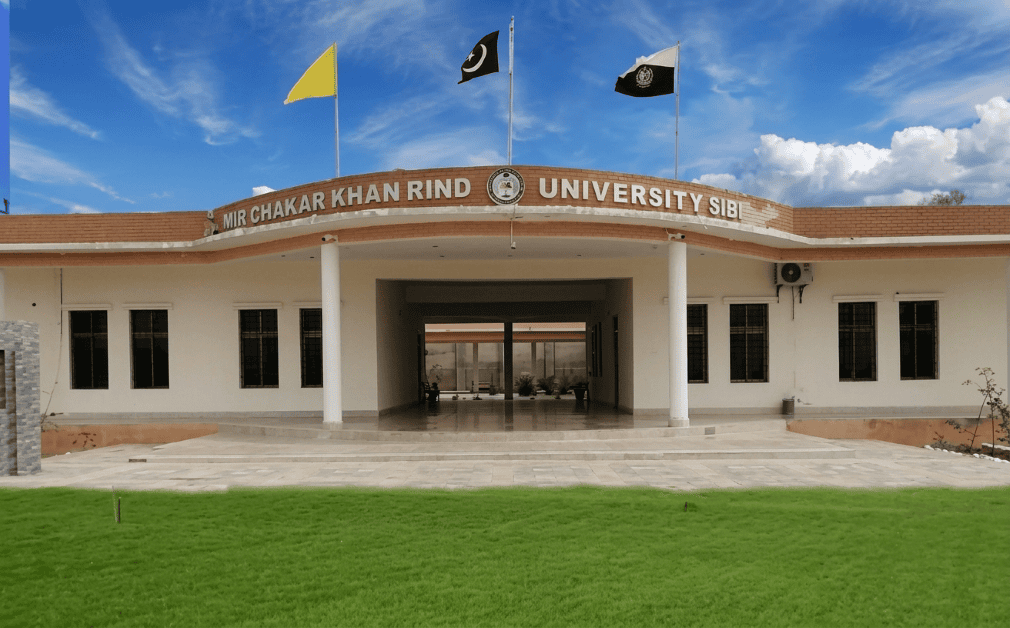
MCKRU is a public-sector, HEC-recognized university sitting on Luni Road in Sibi, Balochistan. It’s a chartered university, co-educational — boys and girls sit in the same classrooms, no separate campuses. It’s still a young institution, built mainly to give rural Balochistan students a real shot at higher education without moving to Quetta or beyond.
If you’re comparing it to bigger names, don’t expect an engineering or medical college here. MCKRU keeps it focused: agriculture, computer science, education, business, English, botany, and law.
Programs and Degrees at MCKRU
Here’s the full offered list, organized by department:
Faculty of Agriculture
- BS Agriculture (4 years)
- MS Agriculture (2 years)
Faculty of Information & Communication Tech
- BS (Hons) Computer Science (4 years)
- MS Computer Science (2 years)
Faculty of Sciences — Botany
- BS (Hons) Botany (4 years)
- MS Botany (2 years)
Faculty of Education & Social Sciences
- B.Ed (Hons) Elementary (1.5 years)
- B.Ed (2.5 years)
- B.Ed (4-year, 8 regular semesters)
- MS Education (2 years)
Faculty of Management Science, Commerce & Economics
- BS (Hons) Business Administration (4 years)
- MS Business Administration (2 years)
- MBA (2 years)
Faculty of Language & Literature
- BS (Hons) English (4 years)
- MS English Linguistics (2 years)
Faculty of Law
- LLB (5 years / 10 regular semesters of 18 weeks each)
Short courses: 1-year diploma courses and 3-month certificate courses, plus a social media management short course — useful if you want a quick skill add-on without committing to a full degree.
Fee Structure at MCKRU
Public-sector pricing, so it’s cheap compared to private universities. Based on the university’s own published fee schedule:
| Program | 1st Semester | Later Semesters | Approx. Total Fee |
| BS (4 years, 8 semesters) | Rs. 31,000 | Rs. 16,000 each | around Rs. 1,43,000 |
| MS / MPhil (2 years, 4 semesters) | Rs. 36,000 | Rs. 19,000, 19,000, 29,000 | around Rs. 1,03,000 |
A few honest notes:
- The first semester is pricier because it bundles admission and registration charges.
- Fees are billed per semester through an online challan system — there’s no monthly installment option, but you’re not paying the whole degree upfront either.
- These numbers can change between admission cycles, so always confirm on the official admissions page before you plan your budget.
Admissions Information & How to Apply
MCKRU runs its whole admission process online through its own portal. Steps:
- Create your fee challan through the university’s e-challan system.
- Register an account using your CNIC/B-Form and basic details.
- Apply online — fill in your academic record (Matric and Intermediate marks).
- Print and submit your application form with documents (Matric/FSc certificates, CNIC, domicile, paid challan copy) to the UGSO/PGSO office on Luni Road, Sibi.
Eligibility is largely merit-based on your Matric and Intermediate marks — MCKRU doesn’t run a big centralized entry test like NUST or FAST. Some departments (Law, for instance) may add an interview stage, so check the department-specific eligibility criteria before applying.
Fall admissions usually open around July and close in mid-August. Exact dates shift a bit every year, so treat the official site as your source of truth, not this article.
Scholarships at MCKRU
This is genuinely one of MCKRU’s strong points for a small regional university. Real, published options:
- MCKRU Need-Based Scholarship: full fee waiver for talented students who can’t afford tuition.
- MCKRU Merit Scholarship: GPA/CGPA of 3.00 or above gets you a full fee waiver for the next semester.
- Top 10% freeship: every semester, the top 10% of students (by previous semester GPA) get an automatic fee concession.
- Financial hardship concession: ranges from 25% to 100% off, based on your family’s situation.
- Work-Study Program: 5% of students get a fee waiver in exchange for campus work.
- BEEF Scholarship: Balochistan Education Endowment Fund gives Rs. 60,000/year to students with 3.00 CGPA or above.
- Benazir Undergraduate Scholarship (formerly Ehsaas): Rs. 40,000/year plus full fee waiver, if your guardian’s monthly income is Rs. 45,000 or below.
- PEEF: for Punjab-domicile students studying at MCKRU.
- Siblings Scholarship: two siblings enrolled together — one gets 50% off. Three siblings — one gets 100% off, another 75%.
- Employee Dependents Scholarship: 90% fee concession for children/spouses of MCKRU staff.
- Orphan Scholarship and Pakistan Bait-ul-Mal Scholarship are also available for eligible students.
Apply through the scholarships office page — most need a form download plus supporting documents.
Campus Life & Culture
Sibi isn’t Quetta or Lahore — it’s a small, hot city (summers here are brutal, some of the hottest in Pakistan), so plan accordingly if you’re coming from outside. The campus itself is on Luni Road, a bit outside the main city.
Honest pros: fees are low, class sizes are small so you’re not lost in a crowd, and the scholarship coverage is unusually generous for a public university this size. There’s also a real push toward practical skills — the university recently ran a freelancing training program (DigiBizz) for students to earn online.
Honest cons: it’s still a developing university, so don’t expect the labs, library, or sports facilities of a big Quetta or Lahore campus. Hostel details aren’t clearly published on the official site — call the admission office directly if you need boarding, since many students from Sibi and nearby areas commute daily instead.
Career paths: CS and business grads typically move into local IT firms, freelancing, banking, or public-sector jobs. Agriculture and botany grads often go into agri-extension departments or NGOs working on food security in Balochistan. Law grads can practice locally or prepare for judiciary and civil service exams. No official starting-salary data is published, so treat any numbers you see elsewhere with caution.
How it compares: If you want engineering or medical programs, or a bigger campus, look at BUITEMS or the University of Balochistan in Quetta — both cost more per semester but offer far more program variety. If you’re a woman looking for a women-only environment, Sardar Bahadur Khan Women’s University in Quetta is the closer fit. MCKRU wins on affordability and its home-turf convenience for Sibi-area students.
FAQs
Yes, it’s a chartered public-sector university recognized by the Higher Education Commission of Pakistan.
Fall admissions typically close in mid-August. Check the official admissions page each cycle since dates shift slightly year to year.
No centralized test like NTS or NAT for most BS programs — admission runs on your Matric/Intermediate merit. Some programs may add an interview.
Roughly Rs. 1,43,000 across 8 semesters, based on the current published fee schedule.
Yes, it’s a co-educational public university with one shared campus.
Merit-based, need-based, BEEF, Benazir, PEEF, siblings, employee-dependent, orphan, and Bait-ul-Mal scholarships — several stack together depending on your situation.
Not clearly listed on the official site — contact the admission office directly for current boarding options.
Phone: 0833-500901. Email: info@mckru.edu.pk. Address: Luni Road, Sibi District, Balochistan.