
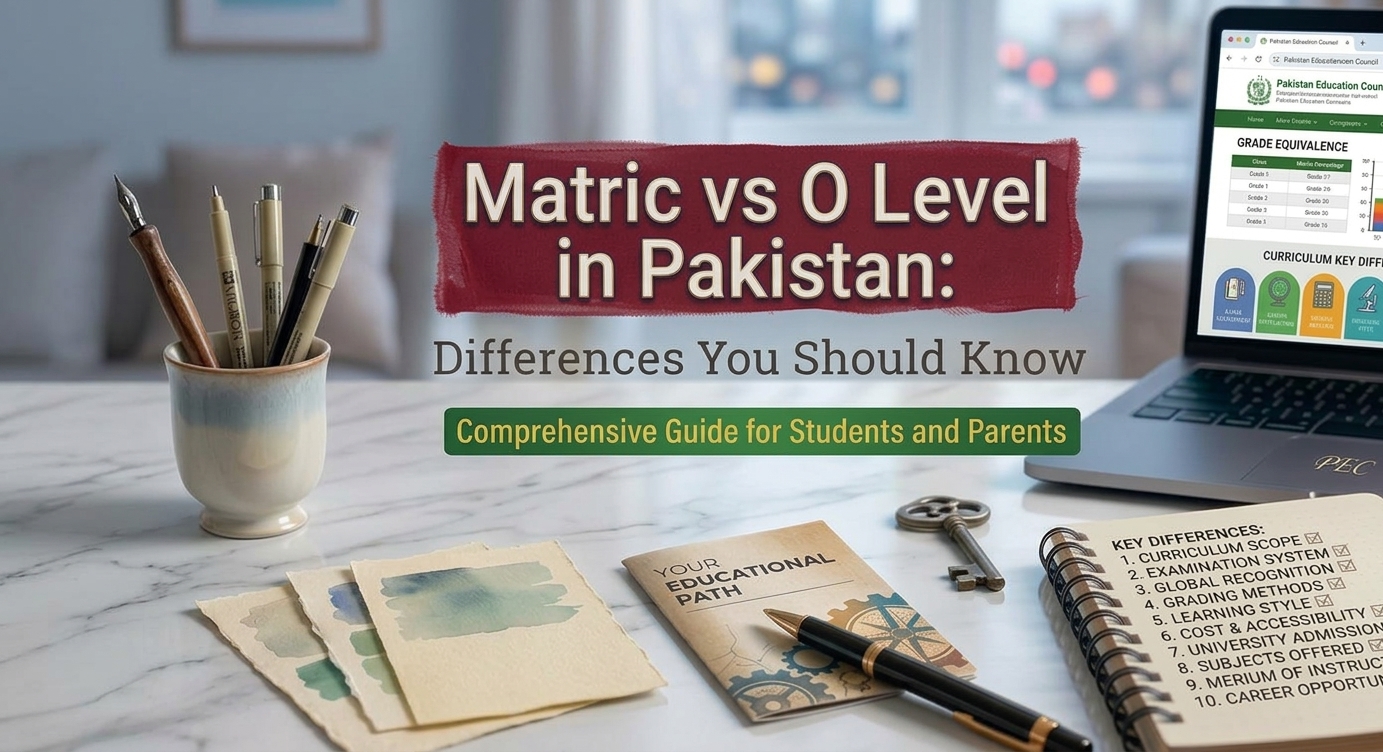
Choosing between Matric and O Level in Pakistan is an important decision for students and parents. Both qualifications can lead to college and university, but they differ in curriculum, subjects, examination style, grading, cost, and study approach.
The right option depends on a student’s academic goals, budget, preferred learning style, and plans for higher education.
What Is Matric in Pakistan?
Matric refers to the Secondary School Certificate (SSC) system followed by schools affiliated with Pakistani education boards. Students normally complete Matric after Classes 9 and 10.
The curriculum is based on the syllabus prescribed by the relevant provincial or federal education board. Students take subjects such as English, Urdu, Mathematics, Physics, Chemistry, Biology, Computer Science, Pakistan Studies and Islamic Studies, depending on their group.
After Matric, students usually move to Intermediate, A Levels, diploma programmes, or other post-secondary options.
What Is O Level in Pakistan?
O Level is an international secondary school qualification offered by examination boards such as Cambridge International and, in some schools, Pearson Edexcel.
Students study individual subjects and sit for internationally recognised examinations. The subjects depend on the school and the student’s chosen combination.
O Level education generally places more emphasis on understanding concepts, applying knowledge, problem-solving and preparing structured answers rather than relying mainly on memorisation.
Matric vs O Level: Main Differences
| Feature | Matric | O Level |
| System | Pakistani education board system | International examination system |
| Typical classes | 9 and 10 | Usually completed over multiple years, depending on the school |
| Curriculum | Local board syllabus | International syllabus |
| Examinations | Provincial/federal boards | International examination boards |
| Subjects | Group-based subject combinations | Individual subject choices |
| Study approach | Can be more textbook and exam focused | Generally more concept and application focused |
| Cost | Usually more affordable | Generally more expensive |
| Recognition | Widely accepted by Pakistani institutions | Widely recognised, with equivalence requirements for many Pakistani admissions |
| Language | Depends on school and medium | Mostly English |
| Next step | Intermediate, A Levels, diplomas and other options | A Levels, Intermediate or other post-secondary pathways |
Curriculum and Study Style
One of the biggest differences between O Level and Matric is how students are assessed.
Matric students follow the prescribed syllabus of their education board. In many cases, preparation is closely connected with textbooks, board examinations and past papers.
O Level students follow an international syllabus. Questions can require students to explain concepts, interpret information, solve problems and apply what they have learned.
This does not mean that every Matric school depends on memorisation or that every O Level school uses the same teaching method. The quality of teaching can vary considerably from one school to another.
Difference in Subjects
Matric students generally choose a group such as Science, Arts or Computer Science, depending on the board and school.
For example, a science student may study Mathematics, Physics, Chemistry and Biology or Computer Science alongside compulsory subjects.
O Level gives students more flexibility because subjects are normally entered individually. A student can choose a combination based on the school’s available subjects and future plans.
However, students planning to study medicine, engineering, computer science or other specialised fields should check the subject requirements before making their choices.
Difference in Examinations
Matric examinations are conducted under the relevant Board of Intermediate and Secondary Education (BISE) or other applicable education board.
O Level examinations are conducted by international examination boards. Cambridge O Level examinations, for example, are assessed through the relevant Cambridge assessment system.
The examination pattern can also differ. O Level questions often test understanding and application, while Matric students prepare according to their board’s examination pattern and syllabus.
Students should check the latest examination syllabus and assessment scheme rather than relying only on older past papers.
O Level vs Matric: Which Is More Difficult?
There is no universal answer.
O Level can feel more challenging because students may need stronger English, conceptual understanding, independent study skills and application-based preparation.
Matric can also be demanding, particularly for students taking science subjects and preparing for competitive college admissions.
A student’s school, teachers, study habits and subject choices can have a bigger impact on difficulty than the qualification name itself.
Difference in Cost
For most families, Matric is the more affordable option.
Government schools and many private schools offer Matric education at comparatively lower costs. Students may also have access to affordable tuition and preparation resources.
O Level usually costs more because schools charge higher fees and students also have examination and other academic expenses.
The exact cost varies from school to school, so parents should compare the complete annual expense rather than looking only at the monthly school fee.
Recognition and Equivalence in Pakistan
Both Matric and O Level can be used for further education in Pakistan.
Matric is already part of Pakistan’s local education system. O Level students may need an equivalence certificate from the Inter Boards Coordination Commission (IBCC) when applying to institutions that require Pakistani SSC equivalence.
For O Level students, the subjects studied can affect equivalence. This is particularly important for students planning to enter medical, engineering, computer science or other specialised programmes.
Before selecting O Level subjects, check the latest IBCC equivalence requirements and the admission requirements of the colleges or universities you may want to attend.
O Level vs Matric for University Admission
Neither qualification automatically guarantees university admission.
Universities usually consider the student’s academic record, required subjects, minimum marks or grades, entry tests and other admission conditions.
For example, a student interested in medicine should check the relevant university and regulatory requirements before selecting O Level or Matric subjects.
The same applies to engineering, computing, business and other professional fields.
Which One Is Better for Pakistani Students?
The answer depends on your goals.
Matric may be a better choice if:
- You want a more affordable education.
- You plan to continue through the local Intermediate system.
- You are comfortable with the Pakistani board system.
- You want easier access to local board resources and preparation material.
- Your preferred college accepts Matric without additional requirements.
O Level may suit you if:
- You prefer concept-based and application-focused learning.
- You are comfortable studying mainly in English.
- Your family can manage the higher cost.
- You are considering international education or qualifications.
- You want more flexibility in selecting individual subjects.
Neither option should be chosen simply because one is considered more prestigious. The quality of the school and the student’s own academic goals matter greatly.
Matric vs O Level After Class 10
After Matric, students commonly move to FA, FSc, ICS, ICom, A Levels, technical education or other intermediate-level programmes.
After O Level, students can move to A Levels, Intermediate and other relevant programmes, depending on institutional requirements.
If you already know your intended career, work backwards from that goal. Check which subjects you need, what grades are expected, whether an entry test is required and whether an equivalence certificate will be needed.
Frequently Asked Questions
Is O Level better than Matric in Pakistan?
Not necessarily. O Level offers an international curriculum and can suit students who prefer conceptual learning, while Matric is usually more affordable and closely aligned with Pakistan’s local education system.
Is O Level equivalent to Matric?
O Level can be considered equivalent to the Pakistani SSC level after meeting the applicable IBCC equivalence requirements. Students should check the latest requirements because subject combinations can affect equivalence.
Is O Level more expensive than Matric?
Generally, yes. O Level schools usually have higher tuition and examination-related costs, although the actual amount varies between institutions.
Can O Level students study in Pakistani universities?
Yes. O Level students can apply to Pakistani universities if they meet the institution’s admission requirements. An IBCC equivalence certificate may be required.
Can Matric students go abroad for higher education?
Yes. Matric students can pursue international education, but the requirements depend on the country, institution and qualification they plan to enter.
Which is easier, Matric or O Level?
Neither is automatically easier. Matric and O Level have different curricula and examination systems. Students should choose the system that matches their learning style and future plans.
Final Verdict
The Matric vs O Level decision in Pakistan should be based on more than reputation.
Matric is generally more affordable and fits naturally into Pakistan’s local education pathway. O Level offers an international curriculum, individual subject choices and an assessment style that often places greater emphasis on concepts and application.
Before making the decision, compare the school, subjects, total cost, teaching quality, future college requirements and IBCC equivalence rules. Choosing the system that matches your academic goals is more important than simply choosing the one that sounds better.