

Introduction
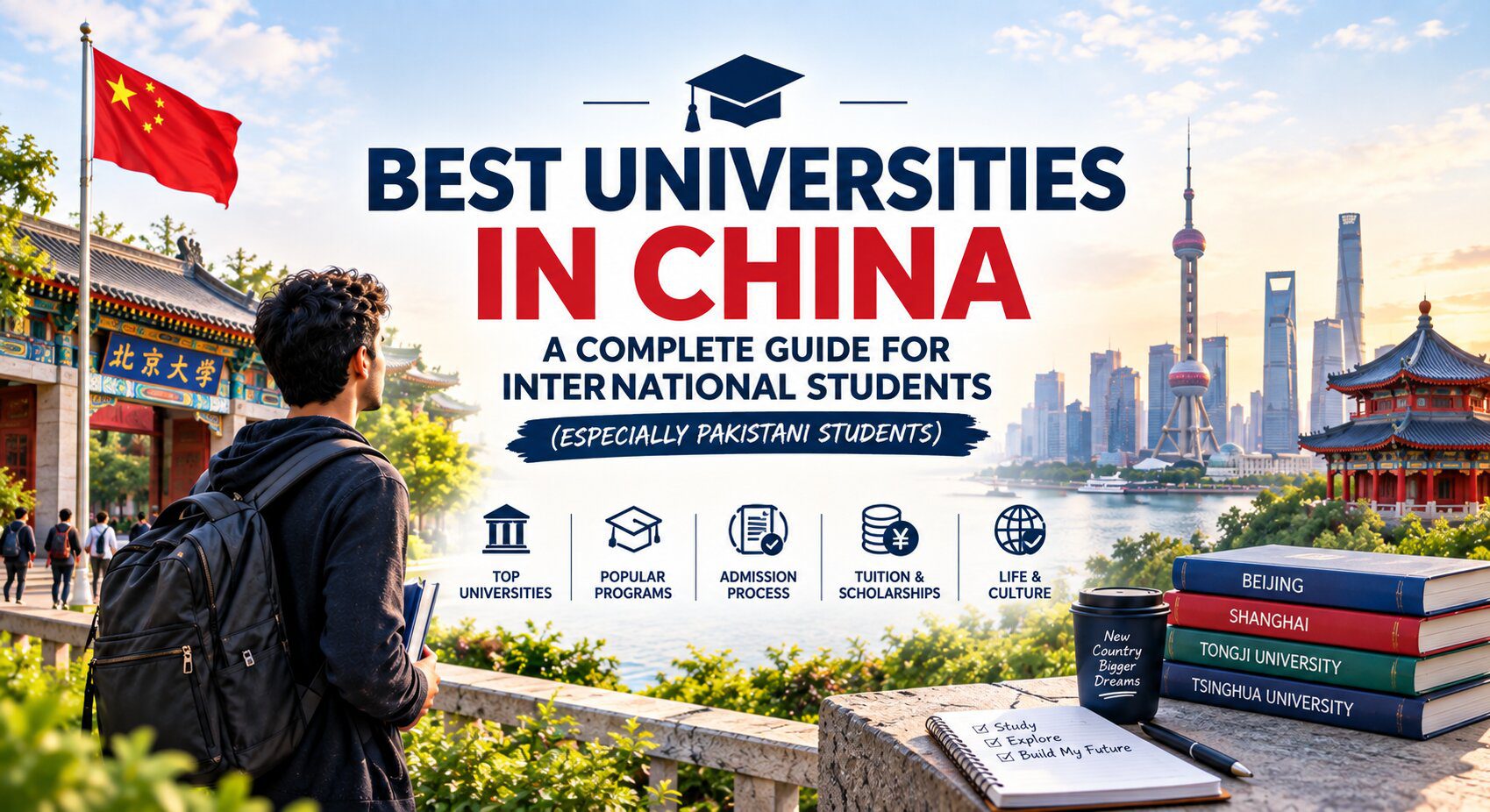
Finding the best universities in China has become a top priority for Pakistani students looking for quality education at an affordable cost. China has emerged as one of the leading study abroad destinations for Pakistani students over the past decade.
In 2025, Pakistan ranked third among all countries sending international students to China, with more than 28,000 Pakistani students enrolled in Chinese universities, and roughly 7,000 of them studying on scholarships.
This guide breaks down the best universities in China for international students, with a specific focus on what matters most to Pakistani applicants: recognized degrees, scholarship access through HEC, realistic costs, and the admission process from start to finish.
Why Pakistani Students Are Choosing the Best Universities in China
There are a few clear reasons behind this growing trend.
Lower cost, similar quality. A full year at one of the best universities in China can cost what a single semester costs in the US or UK. Tuition for most programs runs between $2,000 and $10,000 a year depending on the university and city, far below Western equivalents, while institutions like Tsinghua and Peking University now sit alongside MIT and Harvard in several global rankings.
English taught programs. China now offers more than 2,000 English medium degree programs, so Pakistani students do not need fluency in Mandarin to study most subjects, though many still choose to pick up basic Chinese alongside their degree.
Strong scholarship access through HEC. The Higher Education Commission of Pakistan acts as the official nominating agency for the Chinese Government Scholarship (CSC), meaning Pakistani students have a dedicated, government backed pathway that many other nationalities do not have.
Popular fields. Medicine, engineering, economics, and management remain the most common subjects Pakistani students pursue at the best universities in China, a pattern that has held steady since large-scale Pakistani enrollment began.
List of the Best Universities in China for International Students
China’s leading universities belong mostly to the C9 League, an alliance of nine elite research universities often compared to America’s Ivy League, alongside a wider group under China’s Double First Class initiative. Here are the institutions most often named among the best universities in China.
Tsinghua University (Beijing). Frequently ranked as the top university in China and one of the best in Asia overall. Its MBA program ranks second globally, and it is especially strong in engineering, computer science, architecture, and business.
Peking University (Beijing). One of the most prestigious universities in the country, with academic partnerships across Stanford, Cornell, and Yale that give international graduates strong global credibility.
Fudan University (Shanghai). Hosts one of the most intensive Mandarin language programs in Asia and enrolls the second highest number of international students of any Chinese university.
Zhejiang University (Hangzhou). A C9 League member known for strong engineering, computer science, and life sciences programs, with a large and active international student community.
Shanghai Jiao Tong University (Shanghai). Consistently ranks among the top institutions for engineering, medicine, and business, and is a common choice among CSC scholarship recipients.
University of Science and Technology of China, USTC (Hefei). A smaller but highly research focused C9 member, particularly strong for physics, mathematics, and applied sciences.
Wuhan University and Huazhong University of Science and Technology (Wuhan). Both offer a wide range of English taught programs and are popular with Pakistani students due to lower living costs compared to Beijing or Shanghai.
University of Hong Kong. Offers full English instruction with a British influenced academic structure, and nearly one in four students on campus is international, though tuition and living costs here run noticeably higher than mainland China.
Donghua University (Shanghai). Ranks among the top five most international friendly universities in China and has hosted students from close to 140 countries, making it a strong option for students who want a genuinely diverse campus.
China’s rise in global rankings has been steady, which is part of why the best universities in China now attract students who once looked only at the US, UK, or Australia. In the 2026 US News Global University Rankings, eleven mainland Chinese universities placed in the global top 100, second only to the United States.
Chinese Government Scholarship (CSC): The Main Route for Pakistani Students
Most Pakistani students who study at the best universities in China on a funded basis go through the Chinese Government Scholarship Program, administered by the China Scholarship Council on behalf of China’s Ministry of Education, with HEC Pakistan acting as the nominating agency.
What it covers. Full tuition, dormitory accommodation, medical insurance, and a monthly stipend. International airfare is not included and is paid by the student.
Monthly stipends. Undergraduate students receive around RMB 2,500 per month, master’s students around RMB 3,000, and PhD students around RMB 3,500.
Scholarship numbers. For the 2026 intake, China allocated 75 fully funded scholarships for Pakistani students: 35 for Bachelor’s, 25 for Master’s, and 15 for PhD programs.
Eligibility basics. Applicants must be Pakistani or AJK nationals (dual nationality holders are not eligible), be in good health, and meet age limits: under 25 for undergraduate applicants with FA, FSc, or A Level equivalent, under 35 for Master’s applicants with a completed Bachelor’s, and under 40 for PhD applicants with a completed Master’s, MS, or MPhil.
Test requirement. Applicants generally need a valid USAT score (for undergraduate) or HAT score (for Master’s and PhD applicants), with a minimum score requirement, and recent intakes have also introduced additional assessments, so it is worth confirming the current year’s exact requirement directly with HEC before applying.
How to apply. Applications must go through both the HEC Scholarship Portal (scholarship.hec.gov.pk) and the CSC Portal (campuschina.org), and it is important to note that Pakistani applicants generally must apply through HEC rather than directly to Chinese universities to be considered under Pakistan’s quota.
Deadlines are usually announced between November and January for the following year’s intake, so applying early gives more time to prepare documents and test scores.
MBBS at the Best Universities in China: A Popular but Careful Choice
Medicine remains one of the most common fields Pakistani students pursue at the best universities in China, largely because merit thresholds in Pakistani medical colleges are extremely high and Chinese MBBS programs are comparatively affordable.
Typical costs. Tuition for MBBS programs generally ranges from $3,000 to $10,000 a year, with hostel and living expenses adding a modest amount on top, making the total cost significantly lower than private medical colleges in Pakistan or MBBS programs in the US or UK.
Program structure. Most MBBS programs run five years of coursework plus one year of internship, for a total of six years, and English medium programs typically do not require IELTS or an entry test, though eligibility usually requires around 60% marks in Physics, Chemistry, and Biology.
The recognition question matters most. This is the single most important thing for any Pakistani student to check before enrolling. Only MBBS degrees from universities on the Pakistan Medical Commission’s recognized list are valid for practicing in Pakistan, and this list has changed over time, with some previously accepted institutions later reviewed or removed.
Before paying any fee or accepting any admission offer, confirm the specific university’s current status directly at pmc.gov.pk rather than relying on a consultant’s list or an older article, since recognition status can change between academic years. Even with a recognized degree, returning graduates must still pass the PMC screening test before they can register as licensed doctors in Pakistan.
Cost of Studying and Living in China
Tuition at most non medical undergraduate and postgraduate programs typically falls between CNY 15,000 and 50,000 per year, roughly $2,000 to $7,000, though arts and humanities programs tend to sit at the lower end while medical and engineering programs sit higher.
Living costs vary a lot by city. Beijing and Shanghai are the most expensive, while cities like Wuhan, Hefei, and Nanjing offer a similar academic standard at noticeably lower daily costs. Most students budget somewhere between $250 and $500 a month for accommodation, food, and transport combined, and many universities offer on campus dormitories that keep costs predictable.
International students in China are generally not permitted to take up regular employment while studying, though part time work or internships are sometimes allowed with specific university and immigration permission.
Admission Process and Visa Requirements
- Choose your program and university, keeping in mind whether you are applying through the CSC/HEC scholarship route or applying and paying independently through direct enrollment.
- Prepare your documents early, including academic transcripts, HEC or board attestation where required, recommendation letters, a personal statement, medical certificates, and language test scores if the program requires them.
- Apply through the correct channel. Scholarship applicants go through HEC and CSC portals; self-funded applicants can often apply directly through a university’s international admissions office.
- Receive your admission letter and JW202 or JW201 form, which is required before applying for a Chinese student visa.
- Apply for the correct visa. Most degree students need an X1 visa (for stays longer than 180 days) or an X2 visa (for shorter programs), applied for at a Chinese visa center or embassy using the admission letter and visa application form.
- Complete registration and health checks after arrival, which most universities require within a set number of days of arrival in China.
How to Choose the Right University Among the Best Universities in China
Rather than chasing name recognition alone, Pakistani students should weigh a few practical factors: whether the program is taught in English or requires Chinese proficiency, whether the specific university and specific degree are on the PMC recognized list (for medical students), the total cost of living in that particular city, the size and support available for the existing Pakistani or international student community, and whether the scholarship or self funded route is realistic given the application deadlines each year.
Conclusion
The best universities in China offer Pakistani students a genuinely strong combination of globally ranked institutions, government backed scholarship access through HEC, and significantly lower costs than most Western study destinations.
Tsinghua, Peking, Fudan, Zhejiang, and Shanghai Jiao Tong lead the country’s rankings among the best universities in China, while cities like Wuhan and Hefei offer excellent value for students watching their budget closely.
Whatever program you choose, confirm current HEC and CSC deadlines early, and if you are considering medicine specifically, verify your target university’s PMC recognition status directly before committing any money, since this single check can determine whether your degree is usable back home.