
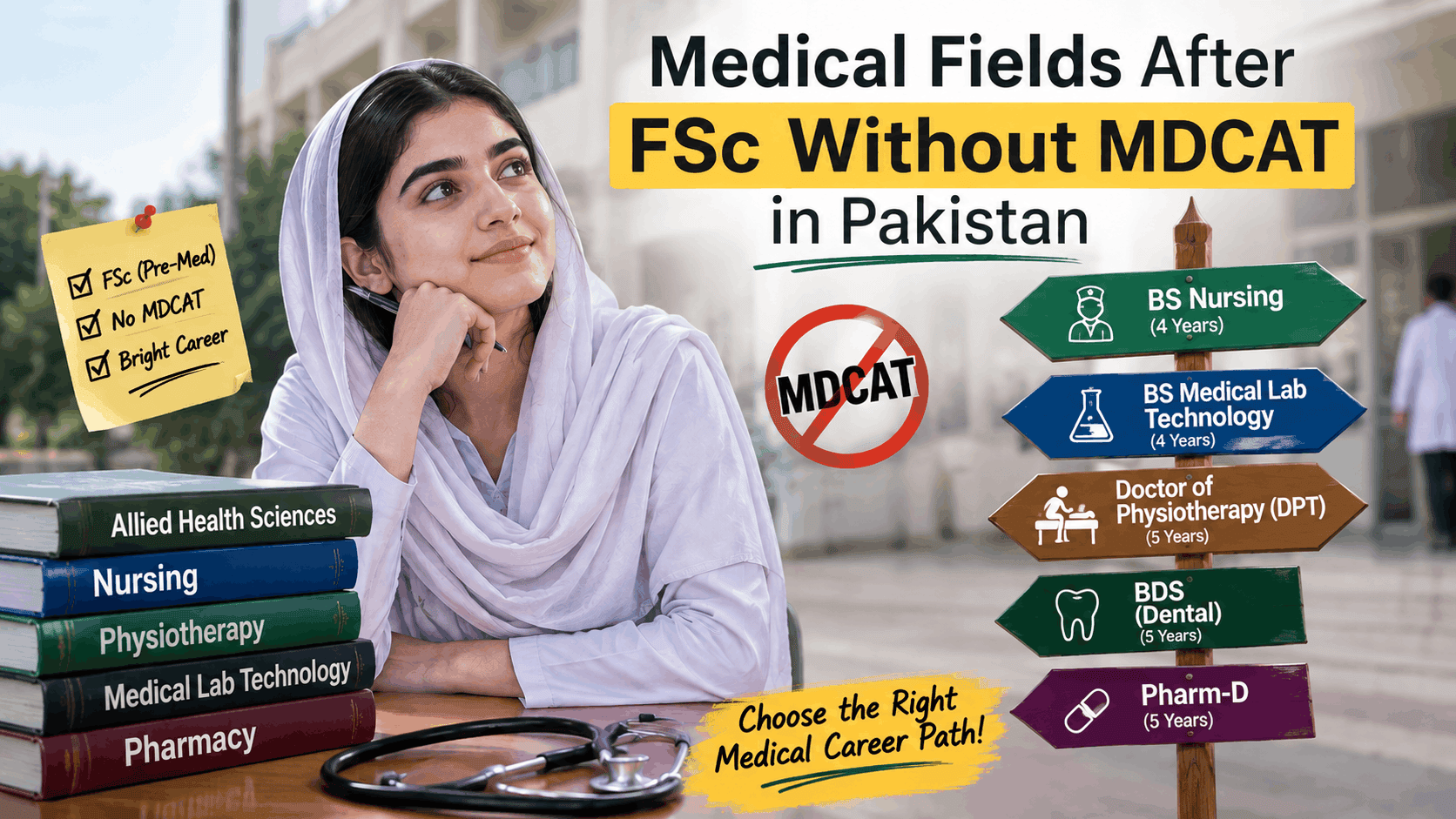
Not clearing MDCAT doesn’t end your medical career. MBBS and BDS are the only fields that actually require it. A wide range of other healthcare professions in Pakistan don’t, and several are genuinely high-demand, well-paying careers on their own.
Why MDCAT Isn’t Required Everywhere
MDCAT is required only for MBBS and BDS, regulated by PMDC. Everything below falls under different regulators, the Pharmacy Council of Pakistan, Pakistan Nursing Council, or the allied health sciences framework overseen by HEC and provincial healthcare commissions, and admits through university entry tests or FSc merit instead.
Core Medical & Allied Health Fields
1. Doctor of Pharmacy (Pharm-D) 5 years. Pharmacy Council of Pakistan. Careers: hospitals, pharmacies, pharma companies, research.
2. Doctor of Physical Therapy (DPT) 5 years. Careers: hospitals, rehab centers, sports medicine, private clinics.
3. BS Nursing 4 years. Pakistan Nursing Council. Needs ~50% in FSc Pre-Medical. High demand locally and abroad.
4. Medical Laboratory Technology (MLT) 4 years. Diagnostic testing and lab analysis. Steady demand as labs expand nationwide.
5. Radiology and Imaging Technology 4 years. X-rays, MRIs, CT scans. Consistent hospital and diagnostic center demand.
6. Nutrition and Dietetics 4 years. Careers in hospitals, private practice, sports nutrition, corporate wellness.
7. Biochemistry or Biotechnology 4 years, research-focused. Careers in labs, pharma companies, biotech, or postgrad study.
8. Dental Technology Diploma or 4-year degree. Makes dental prosthetics: crowns, dentures, braces.
9. Operation Theatre Technology (OTT) 4 years. Manages operation theatres, assists surgeons directly.
10. Health and Hospital Management 4 years. Administrative side of healthcare. Growing demand as hospitals expand.
More Fields Often Left Off This List
11. BS Optometry & Vision Sciences 4 years. Needs ~45-55% in FSc Pre-Medical (varies by university). Diagnoses and treats vision problems, prescribes corrective lenses. Can run an independent practice after a required year of clinical practice. Growing field with strong salary potential.
12. BS Cardiovascular Technology 4 years. Cardiac diagnostics and monitoring, works closely with cardiologists.
13. BS Cardiovascular Perfusion 4 years. Operates heart-lung machines during cardiac surgery, a specialized, high-responsibility role.
14. BS Surgical Technology 4 years. Assists directly in surgical procedures alongside surgeons and OT staff.
15. BS Forensic Sciences 4 years. Crime lab and forensic analysis work, growing field tied to criminal justice.
16. BS Dental Hygiene 4 years. Distinct from Dental Technology, focused on direct patient oral care rather than lab prosthetics.
17. BS Public Health 4 years. Population-level health, epidemiology, and health policy rather than individual patient care.
18. BS Respiratory Therapy 4 years. Treats breathing and lung conditions, demand rose sharply after COVID-19.
19. BS Speech-Language Pathology / Audiology 4 years. Offered at fewer universities. Treats speech, language, and hearing disorders.
20. BEMS (Bachelor of Eastern Medicine and Surgery) Typically 5 years. Regulated separately under the National Council for Tibb, not PMDC. A genuinely distinct path into practicing medicine, rooted in traditional/Unani medicine, without MDCAT.
Short-Term Diploma Options (1–2 Years)
- Diploma in Medical Lab Technology
- Diploma in Radiography
- Diploma in Nursing Assistant
- Diploma in Pharmacy Technician
- Diploma in Physiotherapy
Faster route to work, but generally lower career ceiling than a full degree.
Where These Are Offered
Dow University of Health Sciences (DUHS) Karachi, University of Health Sciences (UHS) Lahore, and Aga Khan University all offer several of these programs, alongside many other public and private universities. Seats, eligibility percentages, and exact program names vary by institution and province, always confirm with the current prospectus before applying.
How to Choose
- Patient contact or lab/technical work? Nursing, DPT, Optometry are hands-on. Biochemistry, MLT, Forensic Sciences lean technical.
- How many years can you commit? Pharm-D, DPT, BEMS: 5 years. Most BS allied health: 4 years. Diplomas: 1–2 years.
- Check the fee structure. Private universities cost significantly more than public ones for the same degree.
- Confirm accreditation with the relevant council, it affects your license to practice later.
Frequently Asked Questions
Pharm-D, BS Nursing, DPT, MLT, Optometry, and Radiology and Imaging Technology are among the strongest, each a recognized, in-demand profession.
At least 20 distinct degree programs, plus several short-term diploma options, spanning direct patient care, diagnostics, and lab-based research roles.
Yes. MDCAT is only required for MBBS and BDS. Every field listed above has a separate admission route.
Pharm-D, DPT, and BEMS: 5 years. Most other BS allied health programs: 4 years. Diplomas: 1–2 years.
DUHS, UHS Lahore, and Aga Khan University offer several, along with many other public and private universities. Confirm current availability directly with each one.
Yes. It’s a growing field with strong salary potential and the option to run an independent practice after your required clinical year.
Diplomas in MLT, Radiography, Pharmacy Technician work, and Physiotherapy take 1–2 years and get you working faster, with a lower career ceiling than a full degree.