
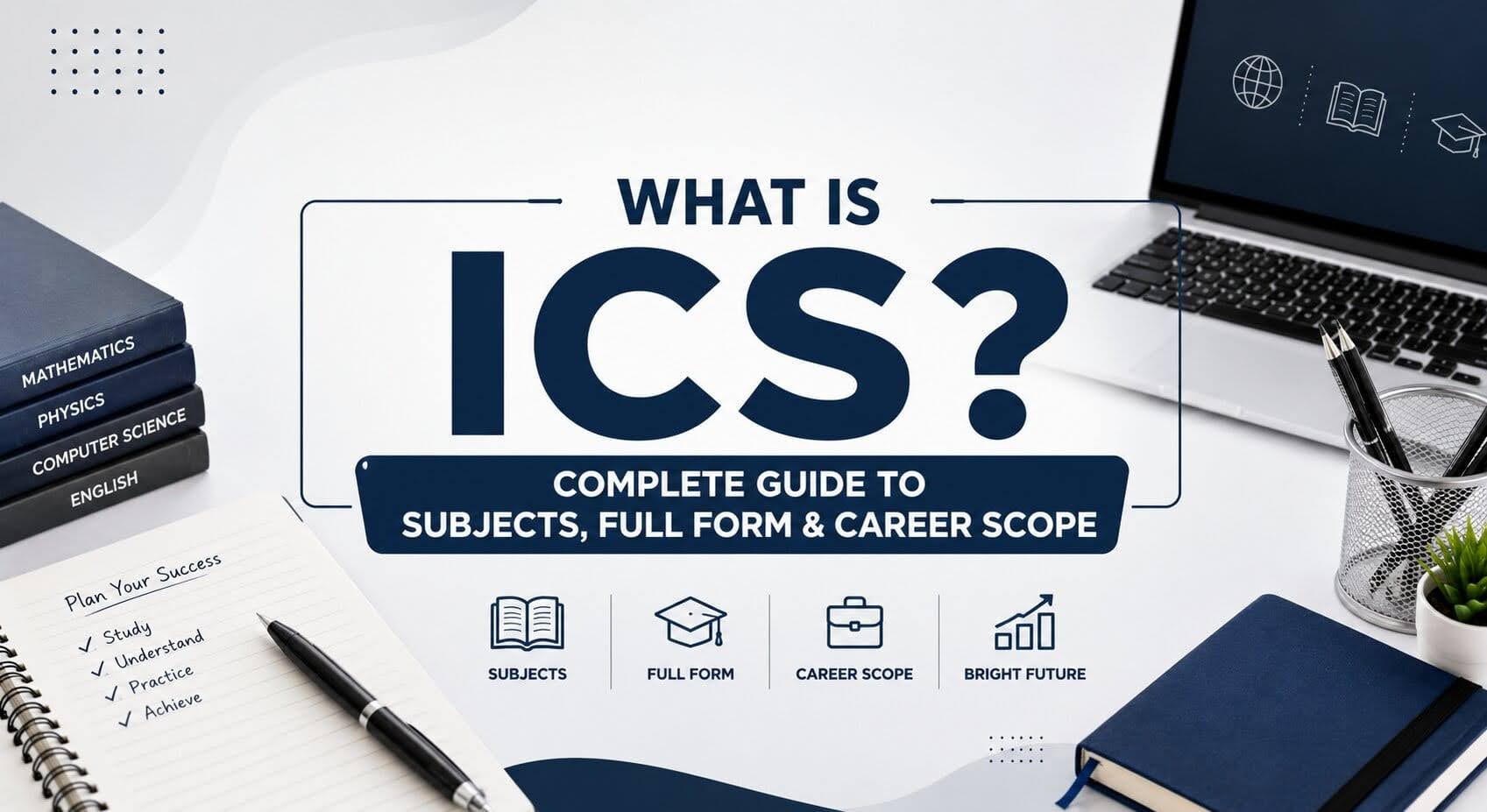
If you’re finishing matric and trying to decide between FSc, ICS, and other intermediate options, you’ve probably typed “what is ICS” into Google more than once. It’s one of the most common intermediate choices in Pakistan, especially for students who like computers and math more than biology or pure sciences, but a lot of students pick it without fully understanding what it actually covers or where it leads. This guide breaks down everything: the full form, the subjects, the marks, and what comes after.
What is ICS in Pakistan?
ICS in Pakistan refers to a two-year intermediate program that focuses on computer science alongside mathematics and physics or statistics. It’s part of the standard Higher Secondary School Certificate (HSSC) system, offered by boards across the country, and it sits alongside FSc, FA, and I.Com as one of the main intermediate streams students choose after matric.
ICS Full Form and What ICS Stands For
ICS stands for Intermediate in Computer Science. The ICS full form is exactly that, a computer science-focused intermediate qualification, distinct from FSc (which leans toward Pre-Medical or Pre-Engineering sciences) and I.Com (which leans toward business and commerce).
ICS Meaning in Urdu
ICS meaning in Urdu is generally understood as “کمپیوٹر سائنس میں انٹرمیڈیٹ” (Intermediate in Computer Science), reflecting the same computer science focus as the English name. Students and parents in Urdu-medium conversations often refer to it simply as “ICS” without translation, since the term is widely recognized as-is across Pakistani education.
What is ICS in Education?
What is ICS in education really comes down to this: it’s designed for students who want a strong foundation in computer science and mathematics without the biology-heavy focus of Pre-Medical FSc. It typically leads toward degrees like BS Computer Science, BS Software Engineering, BS Information Technology, and related tech fields, though it doesn’t lock you into only those options.
ICS Subjects
ICS subjects generally include a mix of compulsory and major subjects across the two years:
- English
- Urdu
- Pakistan Studies
- Islamiyat
- Mathematics
- Physics
- Computer Science
Some boards also offer an ICS-Statistics group, where Statistics replaces Physics as a major subject, more on that below.
ICS Subjects for Class 11
ICS subjects for class 11 (first year of intermediate) typically cover English, Urdu, Pakistan Studies or Islamiyat, Mathematics, Physics (or Statistics, depending on the group), and Computer Science. This first year lays the foundation, particularly in programming basics and core mathematics, that the second year builds on.
ICS Subjects for Class 12
ICS subjects for class 12 (second year) generally continue with English, Mathematics, Physics (or Statistics), and Computer Science, with the compulsory subjects split across both years depending on the board’s specific policy. Computer Science coursework tends to get noticeably more advanced in the second year, covering deeper programming concepts and computer theory.
ICS Statistics Subjects
For students who choose the ICS-Statistics group instead of the standard ICS-Physics group, ICS statistics subjects replace Physics with Statistics as a major subject, alongside the same core Computer Science, Mathematics, English, and Urdu subjects. This group tends to suit students who are stronger in data analysis and less interested in physics-heavy coursework, and it’s a genuinely useful option for students eyeing fields like data science or economics later on.
ICS Total Marks
ICS total marks typically follow the standard HSSC structure used across Pakistani boards: 550 marks per year, adding up to 1,100 marks across both years of intermediate. Exact subject-wise mark distribution can vary slightly by board, so it’s worth checking your specific board’s current marking scheme for the precise breakdown per subject.
Which Field is Best After ICS in Pakistan?
This is genuinely one of the most searched questions among ICS students, and the honest answer is: it depends on your interests, but a few fields consistently stand out.
Computer Science and Software Engineering are the most natural next step, directly building on what you studied in ICS. Information Technology is another strong, closely related option.
Students who took the Statistics group often move toward Data Science, Statistics, or Economics at the degree level. Some ICS students also pivot toward Business Analytics or Artificial Intelligence programs, which have grown significantly at Pakistani universities in recent years.
If you’re asking which field is best after ICS in Pakistan specifically for job demand, Computer Science and Software Engineering currently offer the widest range of opportunities, both locally and through remote/international freelance work.
Can ICS Students Do Engineering?
Yes, but with a catch. Can ICS students do engineering is a common question, and the short answer is: it depends on the engineering discipline and university. Because ICS typically doesn’t include Chemistry (unlike FSc Pre-Engineering), some engineering programs, particularly ones that require Chemistry as a prerequisite, may not accept ICS students directly, or may require you to clear an equivalence or bridging requirement first.
That said, computer-focused engineering fields like Software Engineering, Computer Engineering, or Electrical Engineering at certain universities do accept ICS students, especially where the entry test (like NUST NET) focuses more on Math and Physics than Chemistry. Always check the specific eligibility criteria of the university and program you’re targeting before assuming either way.
Can I Get a Job After ICS in Pakistan?
Can I get job after ICS in Pakistan is a question a lot of students ask, especially if finances or circumstances mean they can’t immediately continue to a bachelor’s degree. The honest answer: ICS alone (without a further degree) qualifies you for entry-level roles like junior IT support, basic data entry, or computer operator positions, but it won’t open doors to higher-paying tech roles like software development, which generally require at least a bachelor’s degree.
The real value of ICS shows up after you pair it with a relevant degree (BS Computer Science, Software Engineering, or IT) or with in-demand certifications and self-taught skills like web development, which many students in Pakistan use to start freelancing even before finishing their degree.
Frequently Asked Questions
Yes, reasonably. ICS keeps you within reach of both tech-focused degrees (Computer Science, Software Engineering, IT) and quantitative fields (Statistics, Data Science, Economics) if you took the Statistics group, which makes it a flexible choice for students who aren’t fully decided.
It helps a lot. Mathematics is a core, heavily weighted subject in ICS across both years, and it also feeds directly into Computer Science coursework like algorithms and logic. Struggling significantly with math usually makes ICS harder than it needs to be.
Neither is objectively harder, they’re just different. FSc Pre-Engineering includes Chemistry alongside Physics and Math, while ICS swaps Chemistry for Computer Science. Which one feels harder usually comes down to whether you’re naturally stronger in chemistry-based sciences or programming and logic.
It’s uncommon and depends heavily on your board and college policy. Generally, switching streams is easier right at the start of intermediate (before or very early in Class 11) than after you’ve already completed a year of ICS-specific coursework.
Yes, reasonably well, since ICS covers the Math and Computer Science foundation these tests often focus on. However, some entry tests also include Physics-heavy sections, so it’s worth checking the specific test’s syllabus against what ICS actually covers before assuming full preparation.