
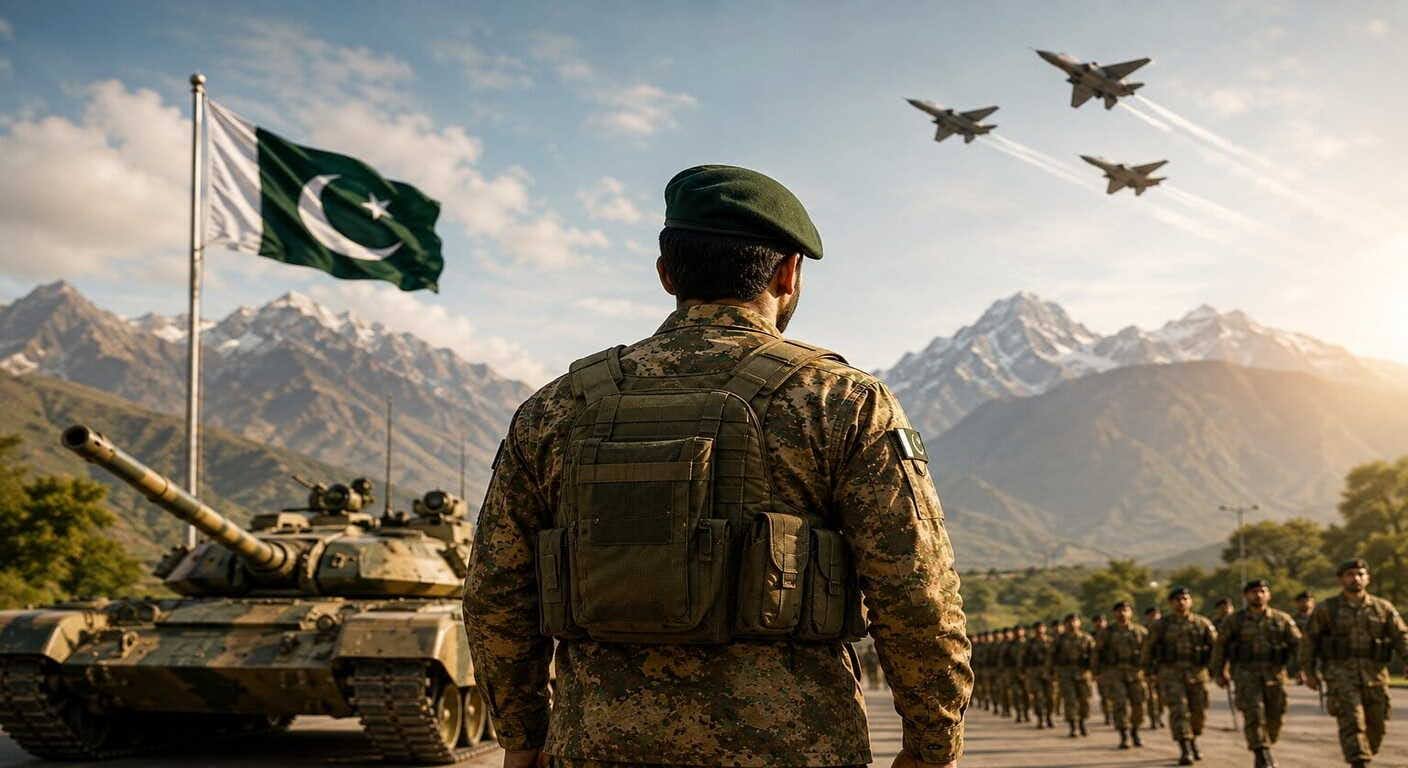
Joining the Pakistan Army is still one of the most respected career moves a young Pakistani can make. Real structure, job security, and a career path most private-sector jobs can’t match. Every year, thousands apply through Pakistan army online registration at joinpakarmy.gov.pk, whether they’re aiming to join right after matric, after FSc, or as qualified doctors, engineers, or graduates in fields the Army needs.
One honest heads-up before we go further. Eligibility percentages, age limits, and course dates get updated with almost every new intake. What’s below reflects criteria widely used in recent courses, but treat it as a starting point, not gospel. Always confirm exact current numbers on joinpakarmy.gov.pk before you plan around them.
Pakistan Army Eligibility Criteria at a Glance
Before the detailed breakdown of each route, here’s the full picture side by side:
| Course | Eligible Gender | Academic Requirement | Age Limit | Starting Rank |
|---|---|---|---|---|
| PMA Long Course | Male | Intermediate (FSc/FA/ICS), 60% marks (55% for relaxation-eligible regions) | 17–22 (up to 23 for 2-year graduates, 24 for 4-year graduates, 25 for serving soldiers) | Second Lieutenant |
| Technical Cadet Course (TCC) | Male | FSc Pre-Engineering/ICS, 65% marks | 17–21 | Second Lieutenant |
| Medical Cadet Course (AMC) | Male & Female | FSc Pre-Medical, 70% marks | 17–21 | Captain |
| Lady Cadet Course (LCC) | Female only | 16-year degree (BS/BE/MA/MSc), 2.5/4.0 CGPA or 62.5% | Up to 28 | Captain |
| Direct Short Service Commission (DSSC) | Male & Female | 16-year degree in a specialized field (IT, Law, Psychology, EME, etc.) | Up to 28 | Captain |
| Soldier (Sipahi) Recruitment | Male | Matriculation, 33–50% depending on trade | 17.5–23 | Sipahi/Private |
Treat this table as a quick reference, not the final word. As mentioned above, exact percentages and age limits shift slightly between course announcements, so cross-check with the official portal before you commit to a route.
The Main Ways to Join
Which route makes sense depends almost entirely on where you are in your education right now.
To join Pakistan Army after matric, your main options are Soldier (Sipahi) recruitment for general duty roles, or a technical/tradesman track if you’re aiming for something like a driver, technician, or cook role. There’s also the option of joining a Cadet College after class 7 or 8, a strong feeder path toward PMA later.
To join Pakistan Army after FSc (or FA, ICS, A-Levels), things open up. PMA Long Course is the classic route into a regular commission. Strong in Pre-Engineering or ICS? The Technical Cadet Course leads to a funded engineering degree plus a commission. Did Pre-Medical? The Medical Cadet Course is worth a serious look, open to both men and women. Women with a Pre-Medical background can also apply through the Armed Forces Nursing Service.
After a 16-year degree, women can join through the Lady Cadet Course. Both men and women with specialized degrees, IT, law, psychology, engineering, and a few other fields, can apply through Direct Short Service Commission.
PMA Long Course: The Main Route to Becoming an Officer
This is the one most people mean when they say they want to “join the Army as an officer.” Two years at the Pakistan Military Academy in Kakul, Abbottabad, ending in a commission as Second Lieutenant.
Generally you’ll need at least 60% in intermediate, though this drops to around 55% for candidates from certain regions, Balochistan, Gilgit-Baltistan, AJK, the former FATA districts, Chitral, Kohistan, Tharparkar, and a few others. Still waiting on your FSc Part 2 result? You can still apply using a Hope Certificate from your college principal, as long as you scored 60% or higher in Part 1.
Age-wise, it’s generally 17 to 22 for intermediate-level candidates, with relaxation for graduates and serving soldiers. Confirm the exact current numbers when a new course opens, these shift slightly between courses.
Technical Cadet Course (TCC)
Good at math and physics and want an engineering degree without the tuition bill? TCC is worth a close look. Selected candidates complete a four-year Bachelor of Engineering at NUST or a military engineering institution, then one year of military training at PMA Kakul. It’s specifically for Pre-Engineering or ICS students, and entry marks tend to sit a bit higher than the regular PMA route.
Medical Cadet Course (AMC)
Open to both men and women. Built for FSc Pre-Medical students who want to become Army doctors. Competitive, unsurprisingly, since it combines a medical career with military service, and it comes with its own entry percentage requirement, generally higher than the standard PMA cutoff.
Lady Cadet Course (LCC)
The main route for women with a completed 16-year degree (BS, BE, MA, or MSc) who want a commission in a non-combat branch. Training runs six months at PMA Kakul, shorter than PMA Long Course since candidates already hold a full degree. LCC officers go into branches like Engineers, Signals, Ordnance, EME, and Army Education Corps, but not combat arms like Infantry or Armoured Corps. Those stay male-only through PMA.
Direct Short Service Commission (DSSC)
Already have a specialized 16-year degree, law, IT, psychology, engineering, or similar? DSSC is a direct path into a commission without the standard cadet pipeline. Open to both men and women, with a more relaxed age ceiling than other entry routes, since it’s built for people who’ve already finished a full degree.
Soldier (Sipahi) Recruitment
The route after matric for general duty roles. Lower academic requirements than officer entry, and a genuinely solid, stable career in its own right, not just a stepping stone. Tradesman and technical soldier roles (drivers, technicians, cooks, and similar) fall in a similar bracket, with specific requirements depending on the trade.
What the Tests Actually Look Like (AS&RC Test Pattern)
Whichever route involves a computerized entry test, here’s roughly what the Pakistan army test syllabus covers at your Army Selection and Recruitment Centre (AS&RC).
A verbal intelligence section first, around 84 questions in 30 minutes, analogies, sequences, coding-decoding. Then non-verbal, about 64 questions in 30 minutes, pattern recognition and shape completion, visual reasoning that doesn’t depend on language at all. Then an academic test, roughly 50 questions in 30 minutes, covering English, Math, General Knowledge, Pakistan Studies, and Islamic Studies.
No negative marking on any of these. Attempt every question rather than leaving blanks. After the written tests comes an initial physical test, a preliminary medical check, and usually a short panel interview the same day or the next.
Pakistan Army Physical Test & Height Requirements
Here’s exactly what’s tested, broken down by candidate type:
| Test Event | Male Cadets (PMA/TCC/AMC) | Female Cadets (LCC) | Soldier Candidates |
|---|---|---|---|
| Running | 1.6 km in 8 minutes | 1.6 km in 14 minutes | 1.6 km in 8 minutes |
| Push-ups | 15 in 2 minutes | Exempt | 15 |
| Sit-ups | 20 in 2 minutes | Exempt | 20 |
| Chin-ups | 3 in 2 minutes | Exempt | 3 |
| Ditch Crossing/Jump | 7.4 ft × 7.4 ft, 4 ft deep | Ditch jump | Same as male cadets |
Female LCC candidates get a more relaxed running time and skip the push-up, sit-up, and chin-up components entirely, though the ditch jump still applies.
On the medical side: minimum height is typically 5 ft 4 in (162.5 cm) for men, 5 ft (152.4 cm) for women, with 6/6 vision (correctable with glasses) and a minimum chest expansion of 31 inches resting, 33 inches expanded, for male candidates.
Flat feet, knock knees, uncorrected vision issues, active hepatitis or HIV, or failing BMI standards can disqualify a candidate here. Worth getting a basic health check done before investing months into written test prep.
If You Clear AS&RC: The ISSB Stage
Clearing the initial tests isn’t the finish line, it’s the entry ticket to ISSB, the Inter-Services Selection Board. Four to five days at centres like Kohat, Gujranwala, or Malir, and a completely different kind of evaluation than anything before it.
Expect psychological tests (Thematic Apperception Test, Word Association Test, Sentence Completion Test), group tasks run by a Group Testing Officer, group discussions, planning exercises, command tasks, and a long personal interview digging into your background and how you think under pressure.
This stage is designed to assess character and leadership potential, not just intelligence or fitness. That’s exactly why serious ISSB preparation matters so much, and why so little of the material floating around online can actually guarantee results.
After ISSB: Final Medical and the Pakistan Army Merit List
ISSB recommends you? Next stop is a full medical board at your nearest Combined Military Hospital. From there, GHQ builds the final merit list from your academic record, initial test scores, and ISSB performance combined. Make the cut, and you’ll get a call-up letter to join your academy.
What Can Get You Disqualified
A few big mistakes will instantly ruin your chances of joining the military, sometimes permanently. First, if you fail ISSB twice for an officer position, you can’t apply again unless you’re going for a specialized master’s level entry later on.
Second, if you ever get kicked out of a military academy for bad behavior or medical reasons, you’re out. Finally, having a criminal record or getting caught submitting fake documents will get you banned for life. You won’t do any of these things by accident, but it’s still smart to know the rules upfront.
Frequently Asked Questions
A newly commissioned Second Lieutenant generally starts somewhere around PKR 80,000 to 100,000 a month including allowances, rising well past PKR 200,000 by the time you reach Major. Exact figures change with pay revisions, so treat this as a rough current range, not a fixed number.
Generally twice in a lifetime for officer commission courses. A third attempt is only possible in specific, limited postgraduate DSSC cases. This is exactly why serious ISSB prep matters more than treating it as a formality after clearing the written tests.
Your CNIC or Form-B, your father’s CNIC, matric certificate and result card, intermediate certificate and result card, recent passport-size photos, plus a valid email and active mobile number. Get these ready before registration opens so you’re not scrambling once the window is live.
Yes. Two-year degree holders can generally apply up to age 23, four-year degree holders (BS, BBA, BA Hons) up to 24, and serving soldiers up to 25. Some routes, like DSSC, allow even more relaxed age limits for specialized degree holders.
Failing any single physical task typically eliminates you from that intake. It’s not a “pass overall, fail one event” situation, each component has to be cleared. This is exactly why physical prep should start well before your test date, not the week of.
PMA Long Course leads to command roles across combat and support arms more broadly. TCC is narrower but comes with a fully funded engineering degree from NUST or a military institution before commissioning. If you specifically want an engineering career track inside the Army, TCC is usually the more direct route. If you want broader options, PMA keeps more doors open.
Not through PMA Long Course, that route remains male-only for combat arms like Infantry and Armoured Corps. Women serve as commissioned officers through the Lady Cadet Course, Army Medical Corps, DSSC, and the Armed Forces Nursing Service, across non-combat branches like Engineers, Signals, EME, and Army Education Corps.
Yes. Beyond combat and general duty roles, the Army also recruits for technical trades (drivers, technicians, cooks), medical and nursing positions, and specialized fields like IT, law, and engineering through DSSC. Each has its own eligibility criteria and entry process.
Through the Medical Cadet Course (AMC) straight after FSc Pre-Medical, or through DSSC if you’ve already completed MBBS/BDS and want a direct commission as a medical officer.
Registration typically opens twice a year, following a consistent biannual pattern. Exact dates shift slightly each cycle, so check joinpakarmy.gov.pk directly rather than relying on last year’s schedule.
Yes. Between the Lady Cadet Course, Army Medical Corps, DSSC, and the Armed Forces Nursing Service, women have several genuine, respected entry points into commissioned roles, each with its own academic and age requirements.
Where to Verify Everything
Given how often specific numbers shift between course announcements, don’t take any percentage, age limit, or date as final until you’ve checked it directly:
- joinpakarmy.gov.pk — official registration and current course announcements
- pakarmy.gov.pk — official Pakistan Army website