

Look at any page of English writing and you’ll spot it almost immediately — that small curved mark sitting just above the line: ‘. It looks tiny and harmless, but few punctuation marks cause as much confusion as the apostrophe. Mix up “its” and “it’s” in the wrong email, and someone will notice.
The good news is that once you understand what an apostrophe is actually doing in a sentence, the rules stop feeling random. This guide breaks the apostrophe down into its two real jobs, walks through the exceptions that trip people up, and ends with a short quiz so you can check what’s actually stuck.
What Exactly Is an Apostrophe?
An apostrophe is a punctuation mark that does two very different jobs in English: it shows that something belongs to someone (Sarah’s laptop), or it marks the spot where letters have been dropped from a word (don’t instead of do not).
It’s easy to mistake it for a comma at first glance, since both are small curved marks. The difference is position: a comma sits on the baseline, while an apostrophe floats above it, tucked into the top corner of a letter.
Where the Apostrophe Actually Comes From
The word “apostrophe” comes from the Greek apostrophos, roughly meaning “turning away” — a nod to how it marks something being left out or turned aside from a word. English inherited the mark through French printers in the 16th century, originally just to show omitted letters. Its use for possession (“the king’s crown”) came later, borrowed from an old habit of writing “his” as a shorthand for possession, which eventually got compressed into the apostrophe-s we use today.
Straight vs. Curly: Two Visual Styles
Before getting into grammar rules, it helps to know that apostrophes don’t always look the same. Word processors and websites typically convert a plain keyboard apostrophe into a curved, “typographer’s” apostrophe automatically. You’ll see both styles depending on where you’re typing:
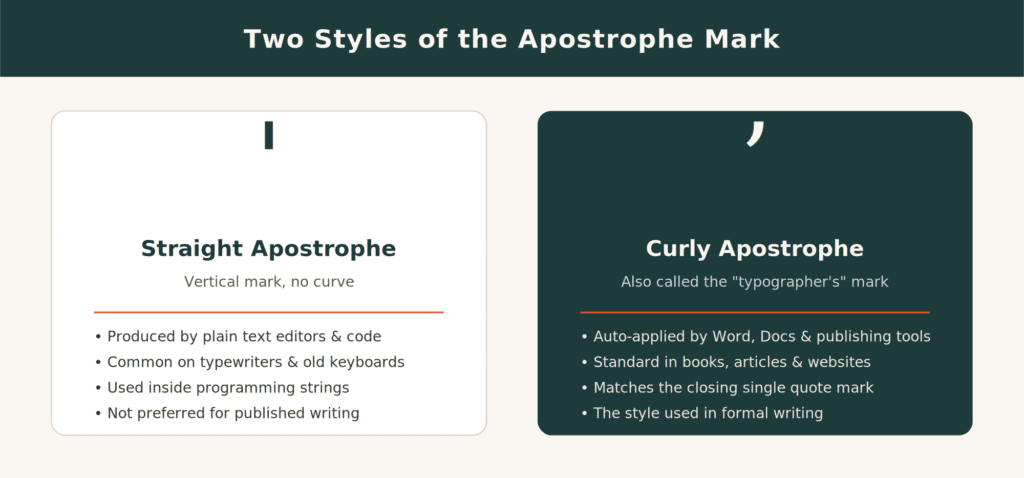
This is purely a visual/formatting difference — it doesn’t change meaning or grammar. But if you’re writing for print or a polished webpage, the curly version is the professional standard.
The Two Types of Apostrophes
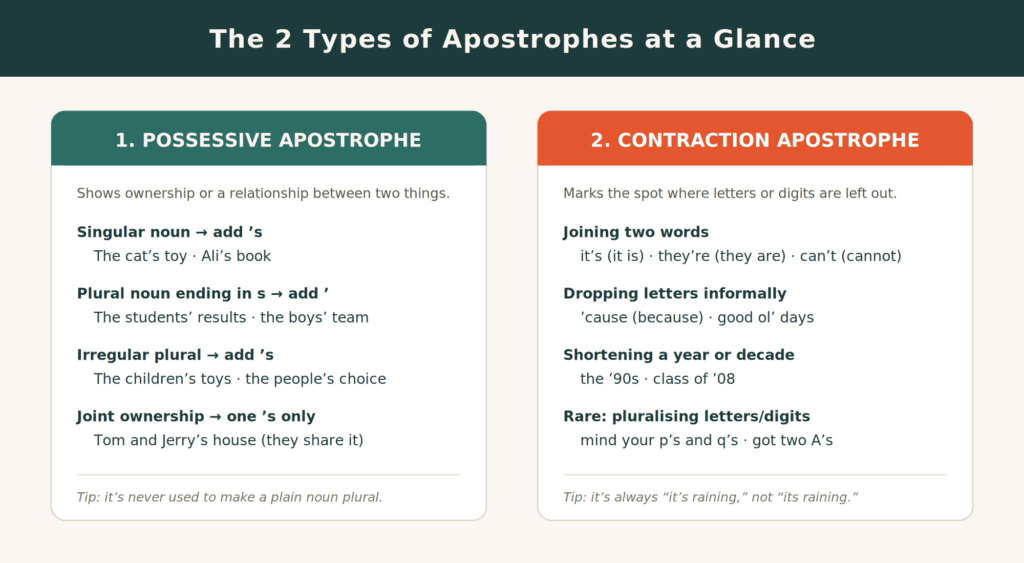
Grammatically, there are only two jobs an apostrophe does. Everything else is a variation on one of these two.
1. The Possessive Apostrophe
A possessive apostrophe shows that one thing belongs to, or is connected with, another. It answers the question “whose?”
Singular nouns — add ‘s
- The dog’s leash
- Maria’s phone
- The company’s policy
Plural nouns that already end in s — add just ‘
- The students’ assignments
- The Khans’ house
- Three weeks’ notice
Plural nouns that don’t end in s — add ‘s (same rule as singular, because the word doesn’t already end in s)
- The children’s playground
- The men’s changing room
- The people’s decision
Joint ownership vs. individual ownership
This is where a lot of writers get stuck. If two people own something together, only the second name gets the apostrophe:
Alex and Sam’s apartment (they share one apartment)
If they each own a separate thing, both names get their own apostrophe:
Alex’s and Sam’s apartments (two different apartments)
A quick note on “its”
“Its” (no apostrophe) is possessive — the company raised its prices. “It’s” (with an apostrophe) is a contraction of “it is” or “it has.” This single mix-up is probably the most common apostrophe error in English, and it happens because “its” looks like it should follow the normal possessive rule, but pronouns like his, hers, its, theirs, and yours never take an apostrophe.
2. The Contraction Apostrophe
A contraction apostrophe sits exactly where a letter (or letters) has been removed to shorten a word or phrase.
Joining two words into one
- do not → don’t
- they are → they’re
- I would → I’d
- should not → shouldn’t
Informal or dialect spellings
- ’cause (because)
- good ol’ days (old)
- rock ‘n’ roll (and)
Shortening years and decades
- the ’90s (1990s)
- the class of ’08 (2008)
A rare third use: pluralizing letters and digits
Occasionally, an apostrophe is used to pluralize single letters or numbers, mainly to avoid confusion:
- Mind your p’s and q’s
- She got three A’s this semester
- There are two 7’s in that number
Most style guides now avoid this for anything except single lowercase letters, since “1990s” and “CDs” read perfectly fine without an apostrophe. This is worth knowing, because different editorial style guides (APA, Chicago, AP) don’t fully agree on when this rare use applies — when in doubt, drop the apostrophe unless leaving it out would actually confuse the reader (e.g., “mind your ps and qs” is harder to read than “mind your p’s and q’s”).
The Most Common Apostrophe Mistake: The “Greengrocer’s Apostrophe”
There’s actually a name for the single most common apostrophe error in English: the greengrocer’s apostrophe. It’s called that because of a long-running joke about hand-written shop signs advertising “banana’s” or “apple’s” for sale — using an apostrophe to make a plain word plural, which is never correct.
❌ We sell fresh apple’s and banana’s.
✅ We sell fresh apples and bananas.
The rule to remember: an apostrophe is never used just to make a regular noun plural. If you’re only talking about more than one of something, and nothing owns anything, you don’t need an apostrophe at all.
Quick Reference Table
| Situation | Rule | Example |
| Singular possession | add ‘s | the cat’s bowl |
| Plural noun ending in s | add ‘ | the dogs’ leashes |
| Plural noun not ending in s | add ‘s | the women’s team |
| Joint ownership | ‘s on the last name only | Tom and Jerry’s cartoon |
| Contraction | ‘ replaces missing letters | can’t, won’t, it’s |
| Decade/year shorthand | ‘ replaces missing digits | the ’80s |
| Plain plural | no apostrophe at all | apples, laptops, ideas |
Test Yourself: Quick Apostrophe Quiz
Try each sentence before checking the answer.
- The (childrens / children’s) toys were scattered everywhere.
- (Its / It’s) going to rain later today.
- We bought two (pizza’s / pizzas) for the party.
- That is (Jess and Mikes / Jess and Mike’s) shared office.
- She was born in the (1990’s / 1990s).
Answers: 1. children’s • 2. It’s • 3. pizzas • 4. Jess and Mike’s • 5. 1990s
If you got four or five correct, you’ve got a solid handle on apostrophes already. If a couple caught you out, re-read the possessive vs. contraction sections above — those two mix-ups (plain plurals and its/it’s) cause almost every apostrophe mistake in everyday writing.
Frequently Asked Questions
Grammatically, there are two: the possessive apostrophe (showing ownership or relationship) and the contraction apostrophe (showing omitted letters or numbers). The occasional use of an apostrophe to pluralize single letters or digits is sometimes treated as a third, minor use.
The 1990s” is correct. No apostrophe is needed to make a year plural — this is one of the most common misuses of the possessive apostrophe.
No. A plain plural (more than one of something) never takes an apostrophe — apples, not apple’s. The apostrophe only appears with plurals when you’re also showing possession, like the apples’ skins.
“Its” shows possession (the dog wagged its tail). “It’s” is short for “it is” or “it has” (it’s raining). Pronouns like its, his, hers, and theirs never use an apostrophe for possession.
In Short
Every apostrophe in English is doing one of two jobs: showing that something belongs to something else, or marking where letters have been left out. Once that clicks, most of the confusing exceptions — joint ownership, irregular plurals, “its” vs. “it’s” — turn out to be small variations on those same two rules, not new ones to memorize from scratch.